

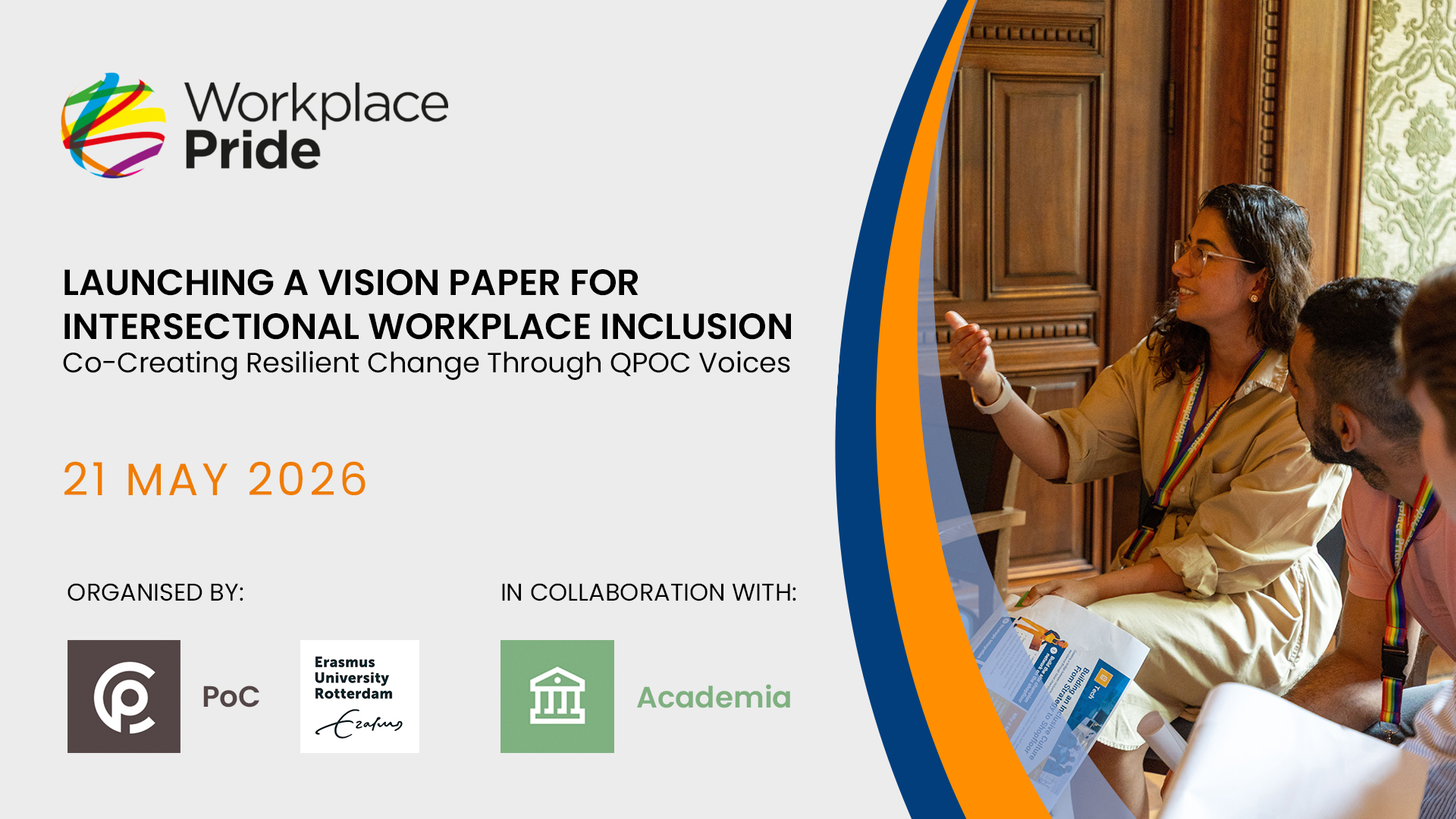
You are invited to the launch of the Workplace Pride Queer People of Colour (QPOC) Vision Paper.
Developed through a collaboration between Erasmus University researchers and Workplace Pride members, this vision paper draws on community dialogues to explore the lived experiences of QPOC employees. It examines intersectional challenges, highlights the perspectives and strengths QPOC professionals bring to organisations, and raises awareness of what intersectional inclusion truly requires, putting forward a vision for workplaces where it becomes a reality.
This paper is the result of a collaboration between Erasmus University researchers and Workplace Pride members. It is grounded in community dialogues and explores the lived experiences of QPOC employees.
Title: Workplace Pride Queer People of Colour (QPOC) Vision Paper
Date: Thursday, 21 May 2026
Location: Erasmus University College, Nieuwemarkt 1A, 3011HP, Rotterdam
Organised by: Workplace Pride PoC Community and Erasmus University Rotterdam
In collaboration with: Workplace Pride Academic Community
The vision paper highlights:
- Intersectional challenges in the workplace
- The perspectives and strengths QPOC professionals bring
- What true intersectional inclusion requires
The paper sets a clear vision for building workplaces where inclusion becomes a reality.
At the launch event:
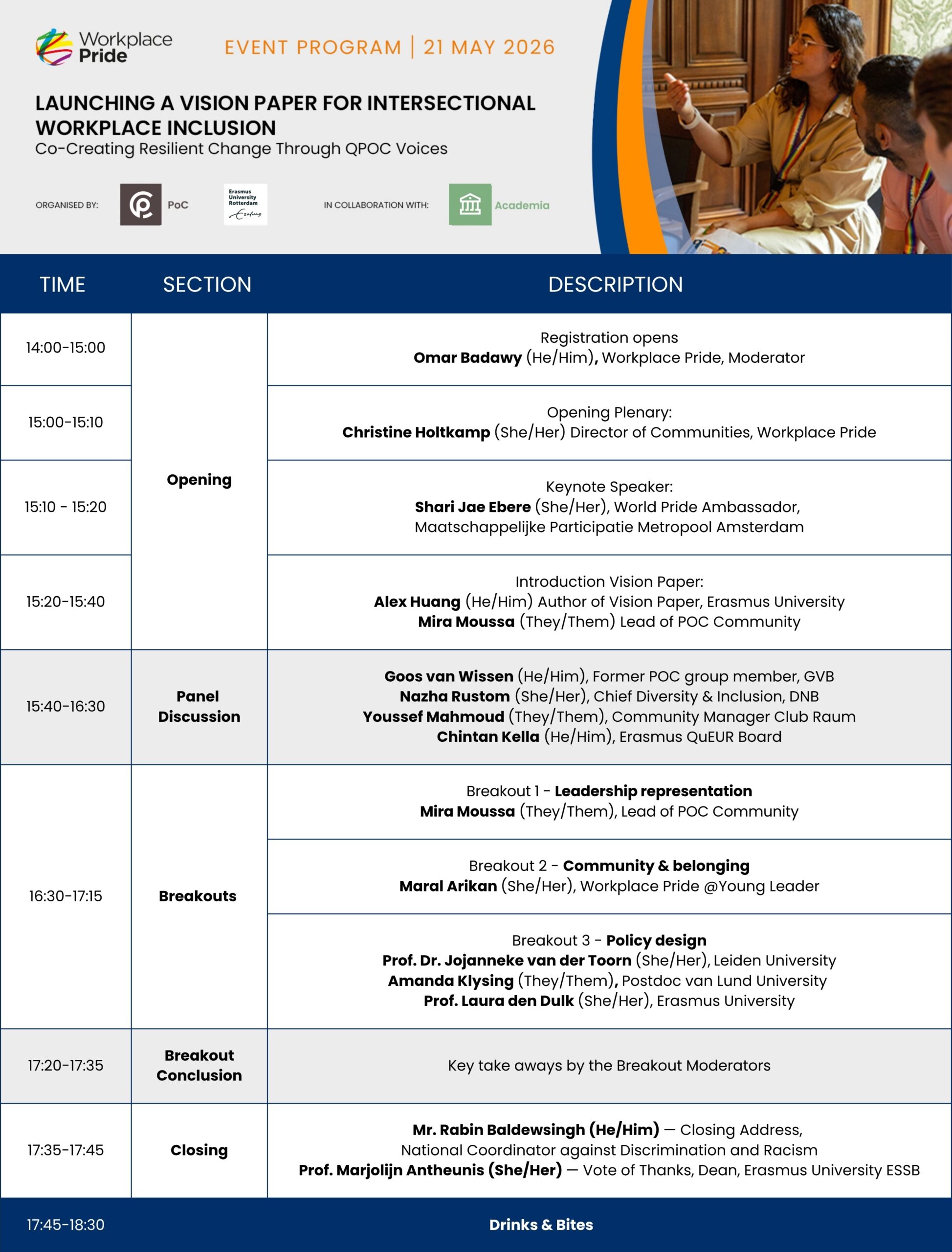
- Speakers will present key research findings
- You will hear real experiences from the community
- Discussions will focus on how organisations can take action
What will be discussed
- Leadership representation
- Community and belonging
- Policy design
Why attend
- Connect with peers across organisations
- Exchange experiences and perspectives
- Contribute to shaping inclusive workplaces
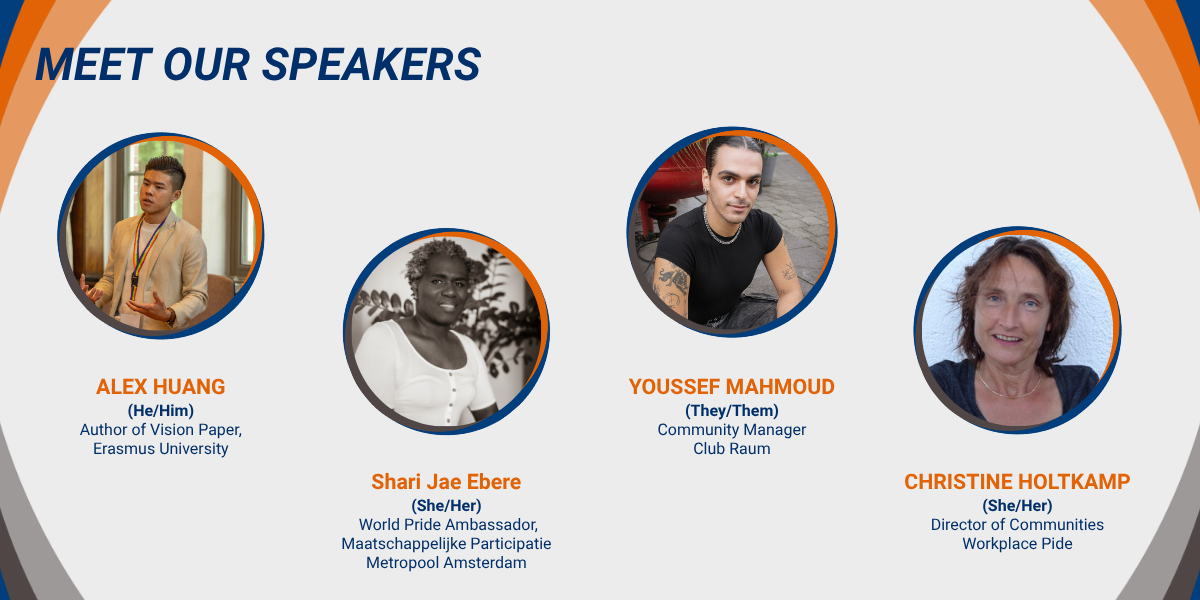

Alex Huang: Author of Vision Paper
Alex (He/Him) is a researcher and executive project officer at the Leiden-Delft-Erasmus Centre for Governance of Migration and Diversity, as well as at the D&I Office at Erasmus ESSB. Originally from Taiwan, his personal experience of navigating belonging as a queer person of colour with a migration background shapes how he approaches this work.
He is the researcher and author of the Vision Paper, co-created with the Workplace Pride POC Community and grounded in three community dialogues with QPOC employees from various organisations. His research focuses on understanding what genuine belonging looks like for individuals whose identities exist at intersections often overlooked by traditional inclusion strategies.
He sees QPOC professionals as co-authors of this work rather than subjects of policy, and believes that meaningful inclusion can only be defined in collaboration with the community itself. The paper reflects this approach by aiming to listen, analyse, and collectively articulate a shared vision for intersectional workplace inclusion in Europe.

Shari Jae Ebere: World Pride Ambassador, Maatschappelijke Participatie Metropool Amsterdam
Shari Jae Ebere (She/Her) was born on February 5, 1967, in Biafra, Nigeria, and she holds Dutch nationality. In 1969, she was brought to the Netherlands as a one-year-old refugee because a very violent civil war was taking place at the time, the Biafran Civil War. In Arnhem, in 1969, she met her foster parents. She went to live with them permanently (not adopted) when she was five years old.
She worked in the corporate sector for 25 years in roles such as Sales Support, Order Manager, Escalation Manager, and Account Manager. She loves working, but due to the heavy physical strain, she was unfortunately declared fully unfit for work in 2016.
Around the age of 47, her gender dysphoria became visible. It was an intense process, but her life experience—growing up with a physical disability, her Biafran background, and her position as a woman of color—gave her the determination to persevere. She still needs that resilience in a world where she moves across many intersections at once. The famous quote by Johan Cruijff, “every disadvantage has its advantage,” is a motto she often applies.
Volunteering plays a major role in her life. For a long time, she trained bus and tram staff at GVB on accessibility. She contributes to discussions about specialized transportation (Supplementary Public Transport) and has held several coordinating roles within the trans community. She is an Ambassador for OV Coach, Ambassador of the 25th Amsterdam Pride edition, and chair of Trans United Europe.
At the end of 2024, she started her own business focused on labor participation for people with a distance to the labor market, with a special focus on LGBTIQ+ people. With her experience and social engagement, she helps make talent visible and resilient and create opportunities. She is also a workplace resilience trainer and provides practical consultancy on accessibility. And when she has time left, she is a DJ with a love for Deep House and Jazz House.

Youssef Mahmoud: Community Manager Club Raum
Youssef Mahmoud (They/Them) is a Cairo-born and Amsterdam-based Community Builder, Door-host, Drag-artist, and Political Scientist; specialising in Public Policy and Governance during their Bachelors and in Gender and Sexuality in Political Science during their Masters.
They’re currently the Community Manager at Club RAUM, where they aim at representing and platforming underrepresented subgroups within the queer community; alongside also being a door host and their professional research which involves topics such as transgender healthcare policy, pink washing & homonationalism, and queer safety during military interventions. In addition to that, their artistic essence and performance combines elements of their background in musical theatre mixed with clubkid-drag, and punk, aiming at pushing the boundaries of identity, the body, sexuality and drag.
Christine Holtkamp: Director of the Workplace Pride Communities
Christine Holtkamp (she/her) is Director of the Workplace Pride Communities, where she works directly with member organisations to strengthen inclusion across LGBTIQ+ networks. She focuses in particular on advancing equity for Queer People of Colour and the Trans+ community groups that continue to face disproportionate discrimination in workplaces and society.
Christine began her career as a nurse in mental and public health, giving her first-hand experience with the impact of inequality on people’s lives. She later expanded her work into human rights and organisational change, taking on roles as a trainer, consultant, manager, and project leader across both national and international contexts. Over the years, she has supported governments, NGOs, educational institutions, and private organizations in turning diversity and inclusion goals into practical policies and day-to-day practices.
Her work spans sectors including healthcare, education, housing, and public administration, where she helps organisations move from intention to measurable progress, whether through leadership development, community-building, or innovation in D&I strategies. Christine is married and lives with her wife in a village near Amsterdam.