
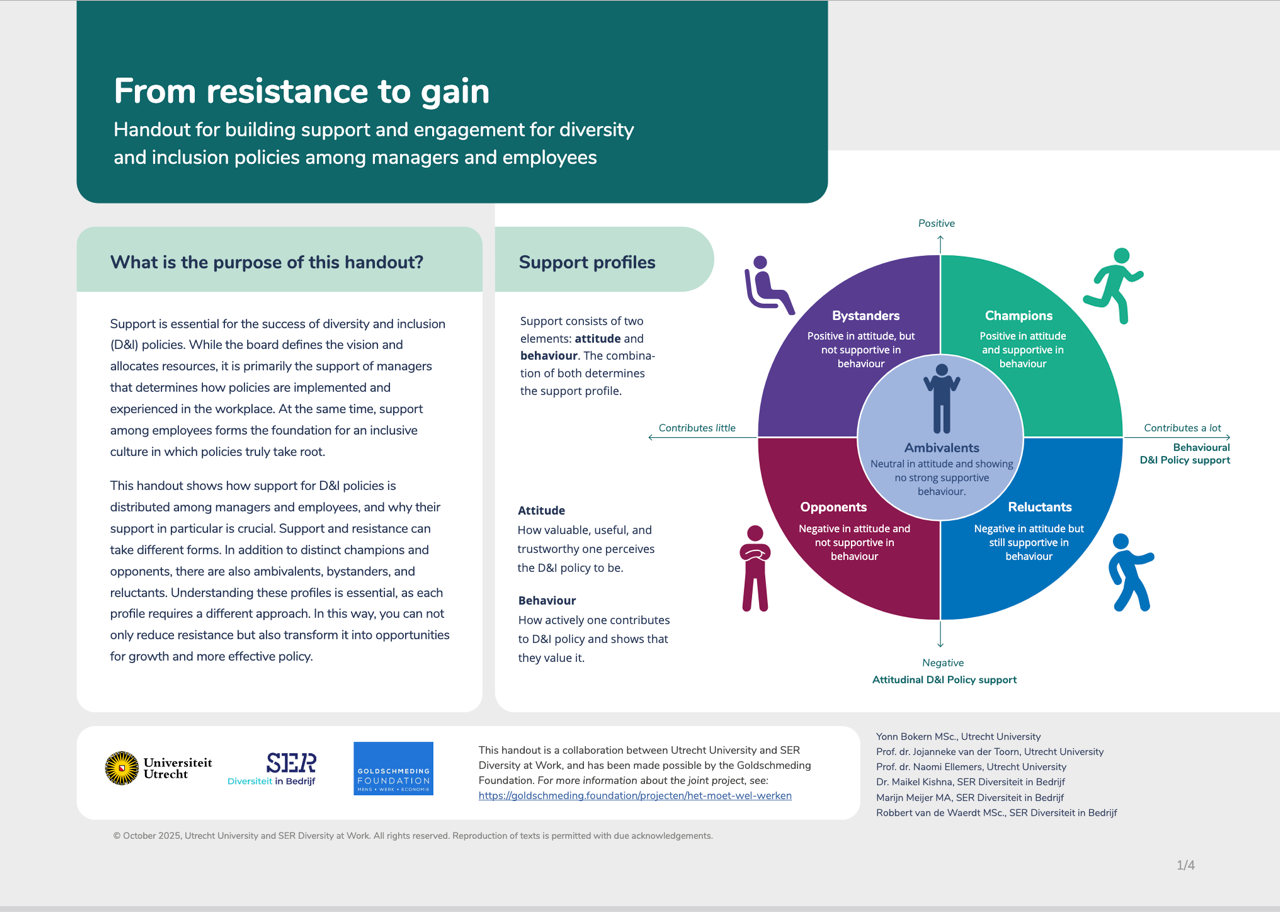
While societal attitudes toward diversity, equity, and inclusion appear increasingly polarized, our research led by Yonn Bokern shows that employees are not simply for or against their organization’s DEI policies. Instead, we identify distinct profiles of support, each driven by different motivations. The challenge, therefore, is not merely to overcome resistance, but to work with it—by listening, engaging, and better understanding the conditions that foster meaningful engagement with D&I policies.
The handout From Resistance to Gain (available in Dutch and English) summarises our research and offers practical advice to better understand support, hesitation and resistance and how to effectively deal with it.
1. Support is more than for or against. Not everyone is distinct champion or opponent. There are also ambivalent employees, reluctants and bystanders.
2. Resistance often is not refusal. The group which is truly against D&I policy, is smaller than expected. More often, it involves unfamiliarity, insecurity or critical questions.
3. Managers are crucial. They typically see themselves as champion or reluctant: convinced of the importance of D&I, but sometimes critical on the execution. Their attitude and behavior strongly influence how inclusive employees experience their working environment.
4. Increase support by understanding profiles. Adjust your approach to your target group: appreciate champions, utilize the critical views of reluctants, inform ambivalents, activate bystanders and enter into dialogue with opponents.
The handout is part of the multiannual project Het moet wel werken, a collaboration between Utrecht University, SER Diversity at work and the Netherlands Inclusivity Monitor, made possible by the Goldschmeding Foundation.