Workplace Pride celebrated its 20th anniversary at its 2026 International Conference in Amsterdam, bringing together business leaders, activists, policymakers, community representatives and allies during WorldPride.
With the theme “Leading with Inclusion”, the conference was a chance to look back at two decades of progress, but also to have an honest conversation about the challenges LGBTIQ+ people and communities are facing today.
One message came through again and again: progress should never be taken for granted. And inclusion cannot be something we only talk about during Pride, write into a policy or put on a campaign poster.
It takes leadership. It takes courage. And, most importantly, it takes action every day.
View All Photos from the Conference Here.
From 20 years of progress to the next chapter
The conference began by looking back at how far Workplace Pride has come since it was founded 20 years ago.
What started with just four organisations has grown into a network of more than 100 organisations across the private sector, public sector and civil society.
David Pollard, Executive Director of Workplace Pride, was quick to emphasise that this progress belongs to everyone who has played a part. It was never the work of one person or one organisation. It has grown through conversations, partnerships, relationships and, above all, people taking action together.
But there was also a clear recognition that the world has changed.
Across many countries, LGBTIQ+ communities are facing political pressure, legislative rollbacks, growing polarisation and renewed attacks on inclusion. For some people, simply being open about who they are at work can still carry real risks.
So the conference was not just about celebrating the past 20 years. It was about asking a much bigger question:
What happens next?
David Pollard: inclusion must move from policy to protection
David Pollard challenged organisations to move beyond statements and policies and focus on what inclusion actually looks like in practice. He reflected on Workplace Pride’s origins and thanked fellow co-founders Marion Mulder and Paul Overdijk.
His message was clear: LGBTQ+ inclusion does not exist in isolation from what is happening in the wider world. When LGBTQ+ rights are challenged or rolled back, employees feel the impact too.
For leaders, that makes inclusion a question of resilience.
It means moving beyond simply meeting legal requirements and towards genuine commitment. It means looking beyond policies and thinking about how people are actually protected.
It also means recognising that there is no single global approach that will work everywhere. Countries have different cultures, laws and social realities, and organisations need to understand those differences.
The challenge was simple:
Make your conversations count. Turn your commitments into action.
Olaf Sleijpen: inclusion is good leadership – and good business
Olaf Sleijpen, President of De Nederlandsche Bank, brought an economic and leadership perspective to the conversation.
He warned against treating inclusion as something that can be quietly put aside when political or economic conditions become difficult.
In fact, he argued that those are exactly the moments when leadership matters most.
Diversity and inclusion are not just social issues. Diverse organisations see things from different perspectives, understand complexity better and are often better equipped to respond when circumstances change.
But creating an inclusive workplace takes more than having the right policies on paper.
It happens in everyday moments: in meetings, in conversations, in the jokes people make, in who gets interrupted and in how leaders behave.
And that makes leadership personal.
People notice what you do. Your everyday behaviour tells employees what your organisation really values.
Leading with Inclusion: turning principles into practice
The first major panel brought together voices from business and government to explore what inclusive leadership looks like in the real world.
The conversation covered practical leadership, role modelling, the role of middle managers, measurement and the business case for inclusion.
One point came up repeatedly: inclusion cannot be left to HR or a specialist DEI team.
● Margot Slattery: Global Head of DEI, ISS
● Martijn van der Graaf: COO Western Europe, Essendi
● Hans Docter: Deputy Secretary General, the Ministry of Foreign Affairs
● Priscilla Baffour, Global Head of DEI, Unilever
It belongs to everyone in a leadership position.
The panel also looked at what happens when budgets are under pressure and organisations are forced to make difficult choices.
The answer was not to stop talking about the business case for inclusion, but to make that case stronger.
Data matters.
Lived experience matters.
And listening to employees matters.
Organisations also need to be able to show whether their efforts are making a difference. Good intentions alone are not enough.
APAC Town Hall: there is no single Asia
The APAC Town Hall brought a different regional perspective to the conference.
- Hanim Hamzah: International Partner, King & Wood Beijing, China
- Senator Pornchai Witayalerdpan: the Thai Government, Bangkok, Thailand
- Zahara Fernandes: Sr. Delivery Director, Managing Director, Accenture, Bengaluru, India
One of its strongest messages was that Asia cannot be treated as a single market or a single political environment.
The region includes huge differences in laws, cultures, social attitudes and levels of LGBTQ+ inclusion. In many places, progress is being driven from the ground up by activists, civil society organisations and local communities rather than through a single top-down approach.
The conversation also showed how personal experience can become a powerful reason to create change.
Speakers shared stories of building communities, creating networks and finding ways to support LGBTQ+ people, even in places where formal structures and support systems were limited.
Another important theme was intersectionality.
People do not experience their identities one at a time. Sexual orientation, gender identity, race, disability, family status, culture and other parts of who we are can all shape our experiences.
That is why a one-size-fits-all approach to inclusion will never be enough.
The APAC discussion also looked towards Thailand’s potential bid to host WorldPride 2030 and what that could mean for further legal and social progress in the region.
Voices of Inclusion: the power of personal stories
In the afternoon, the conversation shifted back to the people at the heart of all this work.
Charlene Liu (She/Her)
Asian Pride, Co-Founder of Ladies Who Tech, Diversity & Inclusion Consulting, & Shanghai Pride
Ipolito T. Mubiru (He/Him)
Executive Director of Vibrant Futures foundation Africa Formerly known as African Diversity and Inclusion Center (ADIC)
Jirim Kim (She/Her)
Attorney at law, GongGam Human Rights Law Foundation
Nichole Pritchard (she/her)
Director of Commercial & Sales Enablement, Metso USA Inc.
The Voices of Inclusion session gave four people the opportunity to share their personal experiences and amplify voices that are not always heard.
Instead of focusing on statistics or corporate policies, the session explored what inclusion actually feels like: identity, community, belonging, resilience and the importance of finding – or sometimes creating – a community of your own.
The stories were a powerful reminder that inclusion is not an abstract idea.
It can affect whether someone feels safe enough to be themselves.
Whether they find people who understand them.
Whether they feel able to progress in their career.
And, ultimately, whether they feel that they belong.
EMEA Town Hall: connecting workplace inclusion with human rights
The European discussion highlighted the close connection between workplace inclusion, democracy and human rights.
- Miriam Kartman: Chief People Officer, KLM
- Christina Jones: VP, DEI, Shell
- Yanna Parnin: Head of SOGIESC Unit, Council of Europe
The Council of Europe perspective underlined that being able to participate fully in the workplace is also part of participating fully in society.
When people are unable to participate equally at work, the consequences can extend beyond their careers. They can affect people’s economic security, social participation and sense of belonging.
The discussion also highlighted the role governments can play in creating the right conditions for businesses to develop and maintain inclusive workplaces.
Business, government and civil society each have a role to play, and their ability to work together remains essential.
The Americas: navigating political uncertainty
The discussion on the Americas explored the very different realities facing LGBTQ+ inclusion across North and South America.
- His Excellency, Hugh Adsett: Canadian Ambassador to the Netherlands
- Leslie Martin: Associate Director Customer Success, Wolters Kluwer
- Luciano Nassif: Country Holding Officer Brazil, ABB
Speakers considered how organisations can continue to protect LGBTQ+ employees while operating in increasingly complicated political environments.
One practical message stood out:
Adapting does not mean abandoning your principles.
Organisations may need to change the way they communicate or operate in response to local circumstances. But that does not mean they have to give up on their underlying commitment to inclusion.
The panel also highlighted the importance of psychological safety, allyship and giving employees the confidence to speak up and know that their voices will be heard.
Leo Varadkar: progress is possible – but never guaranteed
The closing session brought former Irish Taoiseach Leo Varadkar to the stage.
Drawing on Ireland’s transformation from a traditionally conservative and Catholic society to a country that introduced marriage equality and gender recognition, Varadkar offered an encouraging message: change is possible.
But he also made it clear that progress should never be confused with permanence.
Progress can happen quickly.
And it can also be challenged.
Every generation has a responsibility to protect the progress that has already been made while continuing to push for what comes next.
Pride does not stop tomorrow
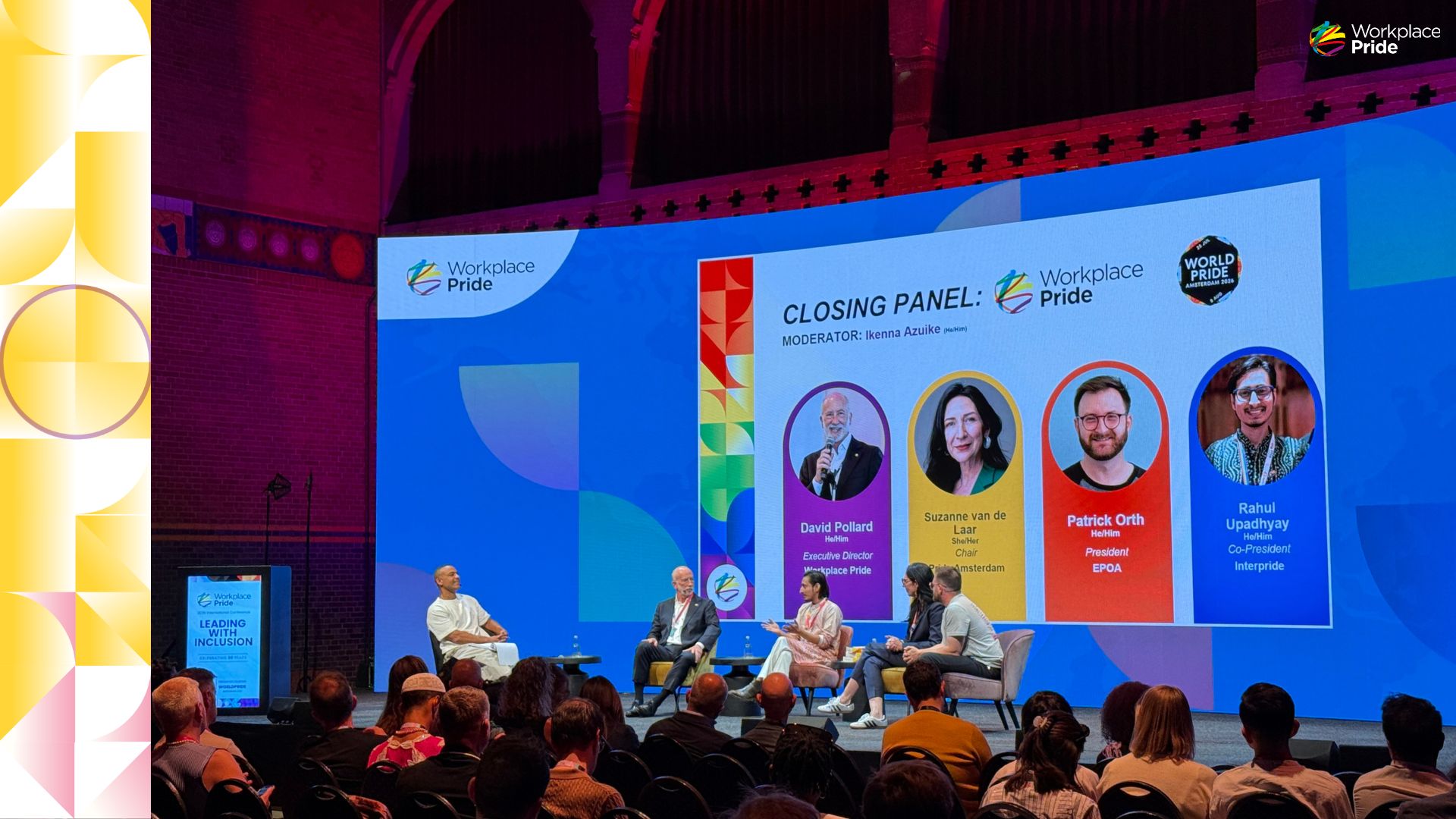
The final conversation brought Workplace Pride and Pride Amsterdam together around one simple but powerful theme: unity.
- Suzanne van de Laar: Chair, Pride Amsterdam
- Rahul Upadhyay: Co-President, Interpride
- Patrick Orth: President, EPOA
- David Pollard: Executive Director Workplace Pride
The closing message was perhaps the simplest of the entire day:
Pride does not stop when the flags come down.
Susanna von der Laar reminded everyone that the work continues for the other 365 days of the year.
David Pollard made a similar point: Pride should never become a seasonal corporate activity that appears for a few weeks each year and then disappears.
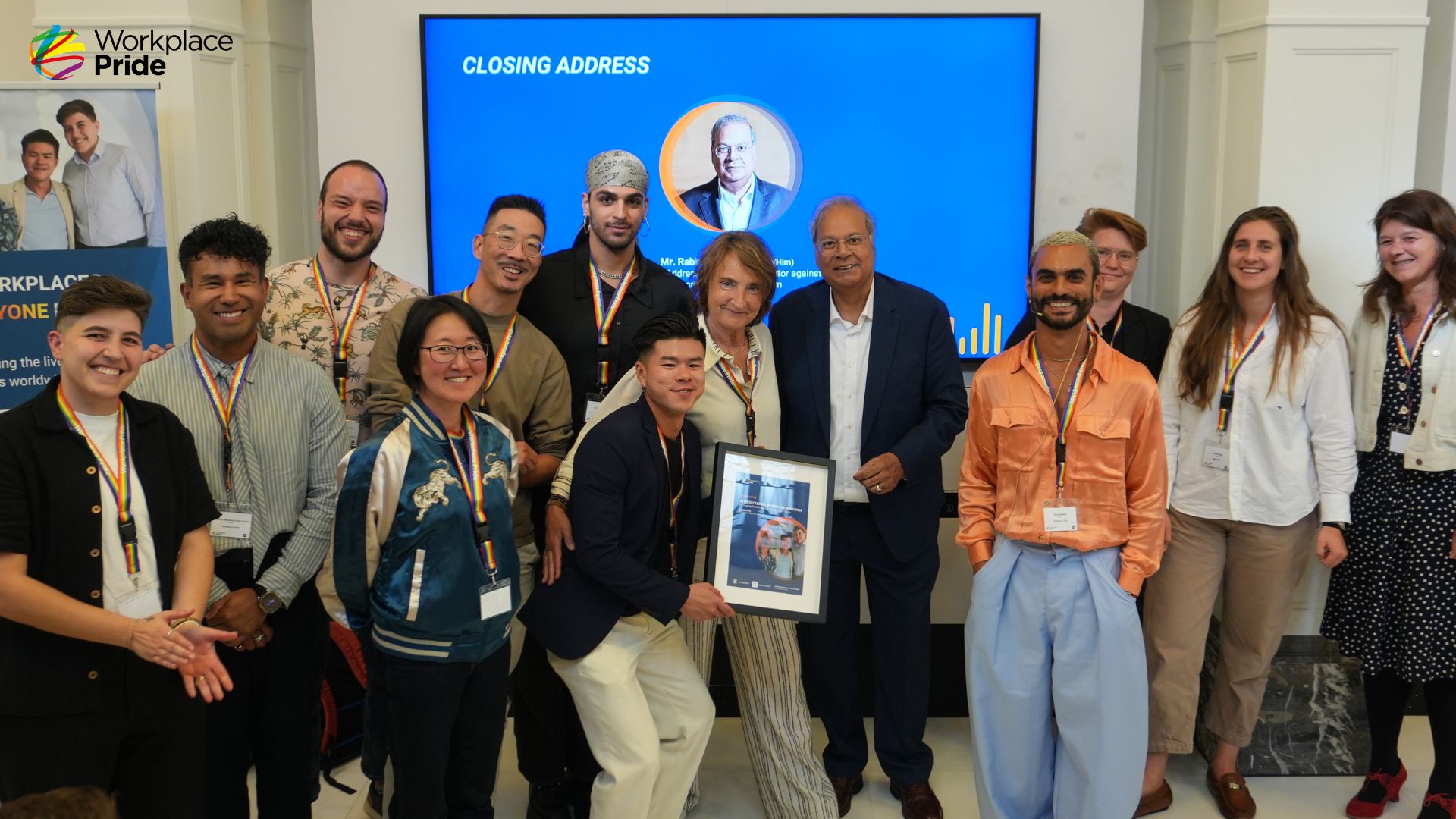
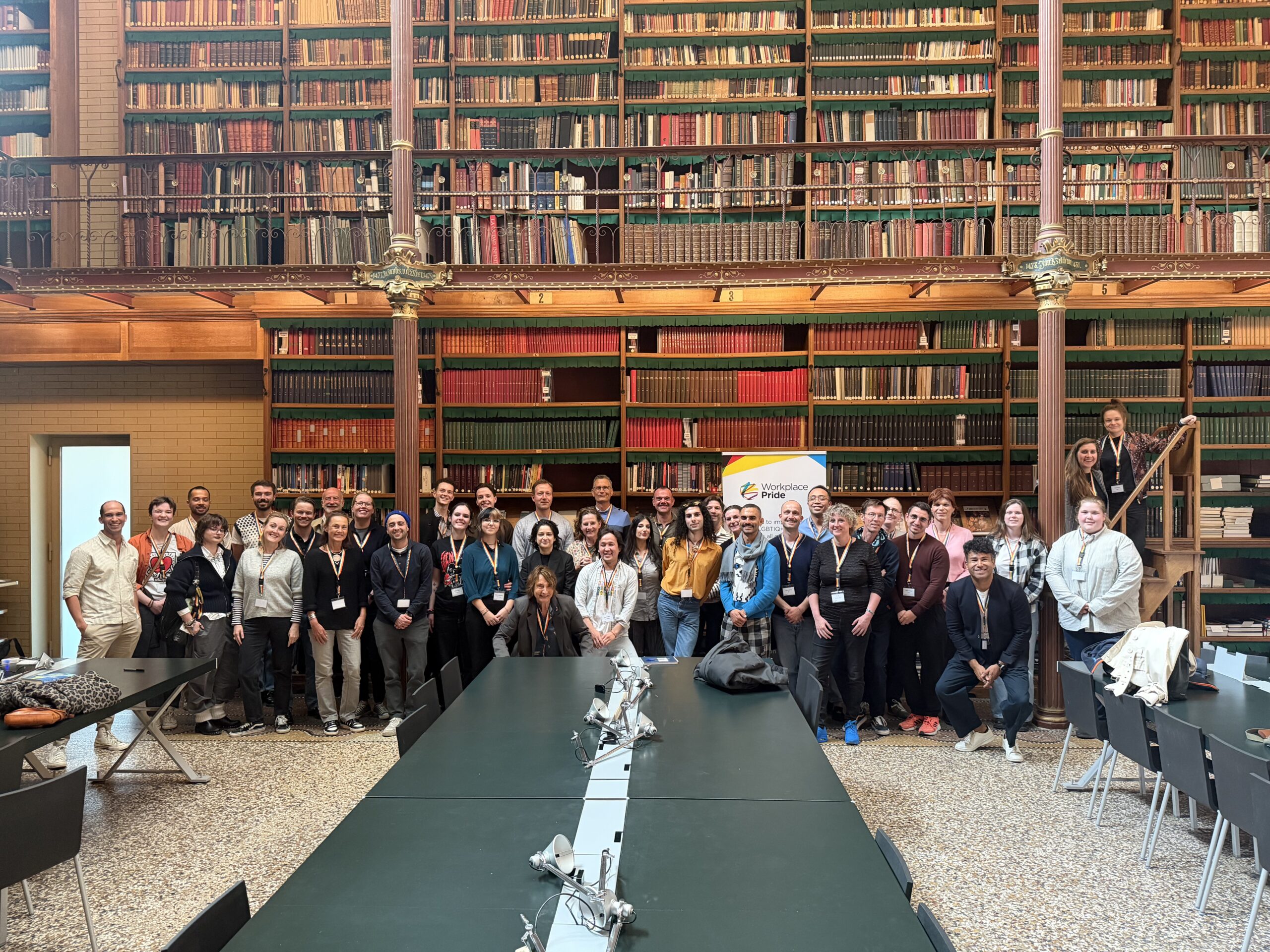
The conference ended by recognising the volunteers, organisers, partners and community members who had helped make the day possible.
David also reflected on what unity means and on the importance of Workplace Pride and Pride Amsterdam continuing to work together.
20 Years Behind Us. What Happens Next?
The 2026 International Conference was both a celebration and a challenge.
The past 20 years have shown what is possible when businesses, civil society, activists and leaders come together — and decide to act.
But the next chapter will require the same courage that helped start this movement in the first place.
The message from Amsterdam was clear:
Don’t step back when things get difficult. Step forward. Lead.
Listen.
Learn.
Adapt.
Speak up.
Protect people.
And, above all, keep creating workplaces where everyone can feel safe, valued and able to be themselves.
20 years brought us here. What happens next is up to all of us.
A Huge Thank You ❤️
None of this would have been possible without the incredible people who made it happen.
To our Board, Advisory Board, staff and volunteers — thank you for your time, energy, commitment and all the work that happens behind the scenes. Your dedication makes a real difference.
To our tech team at Creative Technology — thank you for keeping everything running, solving problems, and making sure everything worked when it mattered most.
To the team at Beurs van Berlage — thank you for your support, partnership and for giving us such a wonderful place to come together.
To WorldPride and InterPride, and especially Martijn Albers — thank you for your collaboration, connection and for helping bring our community together across borders.
And to every single person who showed up, helped out, shared an idea, carried a box, answered a message, welcomed someone, fixed a problem or simply gave their time — thank you.
Big events are never created by one person. They happen because a community comes together.
And last, but most importantly, to the incredible volunteers from Workplace Pride who supported us at the Village and at the Beurs:
Sandra van Scheppingen and Gina Walker — we simply could never have done it without you. ❤️
You gave your time, your energy and your heart to making this conference happen. We are incredibly grateful.
We did it together. 🌈❤️
Thank you to everyone who was part of the journey.
20 years behind us.
The next chapter starts now.