Explore the discussions, insights and practical recommendations from our 2026 International Conference breakout sessions.
Across the morning and afternoon breakout sessions, participants explored key challenges, shared experiences and identified practical opportunities for action. Each session page includes a concise executive summary and key takeaways, together with the presentation slides used during the session.
Bridge the Gap: Engaging Operational & Frontline Teams
Presentation
[View presentation] | [Download Report PDF]
Morning Breakout | Leadership & DEI
This session explored how organisations can translate DEI commitments into everyday practice for operational and frontline teams. Participants examined the role of middle managers, practical approaches to creating inclusive team cultures, and ways to support employees experiencing exclusion or microaggressions.
Executive Summary
The session explored how organisations can bridge the gap between corporate DEI commitments and the everyday experience of operational and frontline employees. The discussion highlighted middle managers as the critical link between policy and practice, with responsibility for shaping team culture, psychological safety, and inclusive behaviours.
Participants emphasised that DEI should not sit alongside operational management as a separate initiative. Instead, it should be embedded into everyday activities such as team meetings, standups, recruitment, team formation, and performance conversations.
A key theme was the need to move from policy and intention to practical action, supported by manager capability, employee feedback, leadership sponsorship, and targeted support for employees experiencing exclusion or microaggressions. Given that frontline employees represent approximately 70–80% of the global workforce, creating an inclusive frontline environment is fundamental to organisational trust, stability, and future ways of working.
Key Findings
- Middle managers are the critical link between policy and practice.
- DEI needs to become part of everyday management.
- Frontline employee experience needs greater visibility.
- Managers need practical tools to respond to difficult situations.
- Global standards need to be balanced with local ownership.
Key Takeaways
- Make DEI operational.
- Equip middle managers.
- Listen to employee experience.
- Focus on the frontline.
- Measure culture locally.
Conclusion
The central message from the session was that DEI becomes real through everyday leadership behaviour. Corporate policies establish the direction, but middle managers determine how employees experience that commitment in practice.
For an organisation where the majority of employees work in frontline or operational roles, inclusion must be built into the daily operating environment. The most effective approach combines clear organisational standards with practical manager capability, employee listening, local ownership, and visible leadership support.
Bottom line: Bridging the gap between corporate DEI commitments and frontline reality requires organisations to make inclusive leadership part of everyday operational management—not a separate initiative.
The Era of AI in Inclusion
Presentation
[View presentation] | [Download Report PDF]
Morning Breakout | Inclusion & the Future of Work
This session explored the opportunities and risks of AI in creating more inclusive workplaces. Participants examined AI’s emerging role as a workplace collaborator, the risk of amplifying social and cultural bias, the tension between safety and privacy, and the importance of ensuring diverse voices are represented in AI development and governance.
Executive Summary
AI is rapidly moving beyond a basic productivity tool towards an increasingly autonomous collaborator capable of supporting complex workplace activities. While this creates opportunities to redesign work and improve inclusion, AI can also reproduce and amplify existing social and cultural biases.
The session highlighted particular risks for LGBTQI+ communities and other underrepresented groups, including stereotyping, underrepresentation and potential misuse of sensitive personal data. Participants emphasised that responsible AI adoption requires human accountability, explicit bias mitigation, strong privacy protections, diverse representation and continuous oversight.
Key Findings
- AI is evolving into a workplace collaborator, creating opportunities to redesign how work is organised.
- AI can reproduce and amplify existing social, cultural and historical biases.
- Bias can have serious consequences when AI is used in areas such as recruitment, healthcare and facial recognition.
- Protecting people through AI can create difficult tensions between safety, privacy and the use of sensitive identity data.
- Marginalised communities need to participate actively in the development and governance of AI.
Key Takeaways
- Keep humans accountable.
- Build inclusion into AI from the start.
- Identify and mitigate bias.
- Protect sensitive data.
- Ensure diverse representation.
- Ask who benefits, who could be harmed and whose voice is missing.
Recommended Actions
- Introduce explicit bias and inclusion assessments into AI development and procurement.
- Maintain clear human accountability for AI-supported decisions.
- Protect sensitive identity-related data through strong privacy safeguards.
- Include diverse voices in AI development, testing and governance.
- Continuously monitor high-impact AI systems for unintended consequences.
- Consider the wider social, environmental and global implications of AI adoption.
The Multiplier Effect: Creating Impact Through Partnerships
Presentation
[View presentation] | [Download Report PDF]
Morning Breakout | Partnerships, Inclusion & Organisational Impact
This session explored how partnerships can amplify the impact of inclusion initiatives. Starting with a personal story and the creation of a Pride exhibition, participants examined how collaboration across organisations and Employee Resource Groups can create greater visibility, spark meaningful conversations and broaden the focus from individual communities to identity and belonging.
Executive Summary
The discussion demonstrated how a clear vision and authentic personal stories can grow into high-impact organisational initiatives. The Pride exhibition used real-life experiences and historical perspectives to reach audiences beyond the LGBTIQ+ community, while its later evolution into a broader identity campaign created opportunities for collaboration across different ERGs.
Participants also explored the realities of partnership building, including securing management support, navigating organisational maturity, aligning values and managing differences across geographical and cultural contexts.
Key Findings
- Personal stories can become powerful catalysts for wider organisational conversations.
- Inclusion initiatives should be designed to reach audiences beyond the communities directly represented.
- Partnerships across ERGs and organisations can significantly multiply reach and impact.
- Authentic employee stories can be more powerful than relying solely on recognised public figures.
- Successful partnerships require shared values, a clear purpose and meaningful organisational commitment.
- Inclusion initiatives can create impact beyond the original event by generating conversations and encouraging action.
Key Takeaways
- Start with authentic stories.
- Design for visibility.
- Build through collaboration.
- Keep people at the centre.
- Connect inclusion to business.
- Measure the ripple effect.
Recommended Actions
- Develop a clear vision and business case before approaching partners.
- Create opportunities for collaboration across different ERGs and identity groups.
- Establish clear criteria for selecting external partners.
- Design campaigns to reach audiences beyond the communities directly represented.
- Use authentic employee stories as a central part of inclusion initiatives.
- Build clear expectations around partner commitment, resources and accountability.
2026 Vision
The initiative will continue to evolve through a new Diversity Day concept built around the theme:
“The Beauty Within: Seeing Beyond What the Eye Sees.”
The campaign will use photography and personal stories to encourage people to look beyond what is immediately visible and consider the identities and experiences that shape each individual.
Moving ERGs from “Nice to Have” to Business Critical
Presentation
[View presentation] | [Download PDF]
Morning Breakout | ERGs, Strategy & HR Integration
This session explored how Employee Resource Groups (ERGs) can move beyond visibility and become strategic partners to HR and the wider organisation. Participants discussed how ERGs can align with business strategy, demonstrate measurable impact, influence policy and culture, strengthen representation, and build sustained leadership support.
Executive Summary
The session highlighted the importance of connecting ERG objectives directly to organisational strategy and DEI priorities. Participants explored how strong partnerships between ERGs, HR, People Analytics and leadership can help identify inclusion blindspots, support cultural change, and bring authentic lived experiences into organisational decision-making.
The discussion also emphasised the need to demonstrate ERG impact through data, communicate successes visibly, and build ongoing relationships with both executive and middle management. The strongest ERGs are positioned not simply as employee communities, but as strategic partners that can contribute to culture, talent, policy and business outcomes.
Key Findings
- ERGs create greater impact when their objectives are clearly aligned with company strategy and DEI priorities.
- Strong partnerships with HR can help ERGs identify inclusion gaps and influence policy and culture.
- ERG impact should be measured through meaningful data, surveys and targeted reviews.
- Leadership support is most effective when it is visible, ongoing and supported by clear evidence of impact.
- ERGs can strengthen recruitment, representation and employer reputation by demonstrating authentic inclusion.
- Lived experience provides valuable insight for improving policies, employee experience, products and services.
Key Takeaways
- Align ERGs with strategy.
- Build strong partnerships with HR.
- Measure and communicate impact.
- Create visible and sustained leadership support.
- Use lived experience to drive change.
- Move from visibility to strategic value.
Recommended Actions
- Align ERG objectives with relevant business and DEI priorities.
- Establish clear working relationships between ERGs and HR.
- Develop meaningful measures to track ERG reach and impact.
- Regularly share data-driven results with leadership.
- Create a routine of leadership engagement and accountability.
- Invite executive and middle management to ERG events and discussions.
- Share ERG successes and personal stories through high-visibility channels.
Voices of Inclusion: the power of personal stories
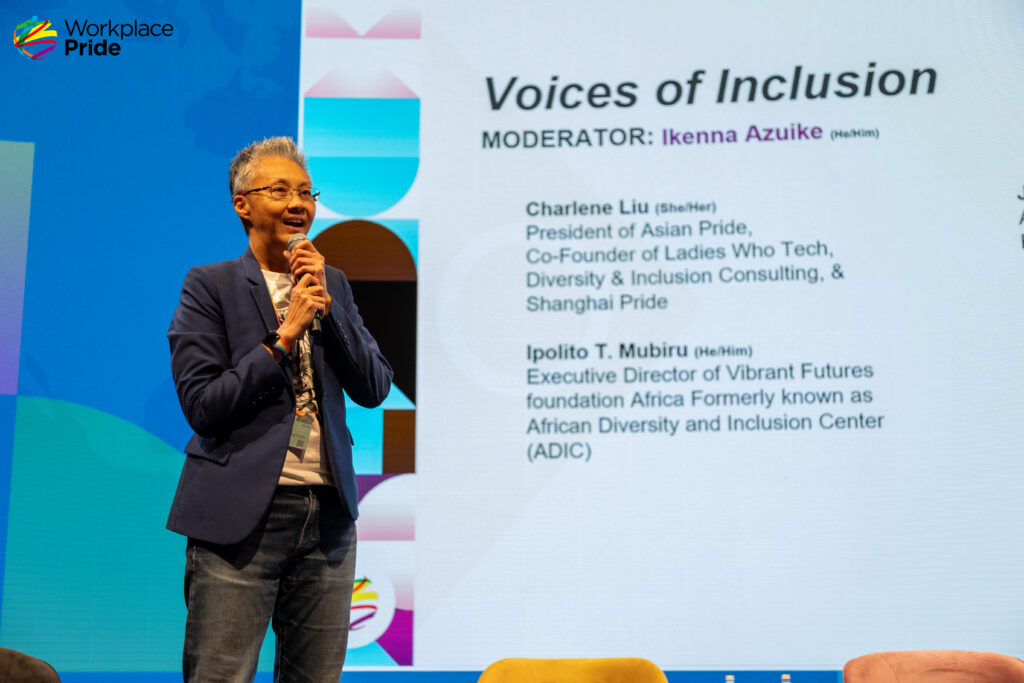
Voices of Inclusion: the power of personal stories
In the afternoon, the conversation shifted back to the people at the heart of all this work.
Charlene Liu (She/Her)
Asian Pride, Co-Founder of Ladies Who Tech, Diversity & Inclusion Consulting, & Shanghai Pride
Ipolito T. Mubiru (He/Him)
Executive Director of Vibrant Futures foundation Africa Formerly known as African Diversity and Inclusion Center (ADIC)
Jirim Kim (She/Her)
Attorney at law, GongGam Human Rights Law Foundation
Nichole Pritchard (she/her)
Director of Commercial & Sales Enablement, Metso USA Inc.
The Voices of Inclusion session gave four people the opportunity to share their personal experiences and amplify voices that are not always heard.
Instead of focusing on statistics or corporate policies, the session explored what inclusion actually feels like: identity, community, belonging, resilience and the importance of finding – or sometimes creating – a community of your own.
The stories were a powerful reminder that inclusion is not an abstract idea.
It can affect whether someone feels safe enough to be themselves.
Whether they find people who understand them.
Whether they feel able to progress in their career.
And, ultimately, whether they feel that they belong.
EPBN: Business Impact of EU LGBTIQ+ Legislation
Presentation
[View presentation Business Impact of LGBTIQ+ EU Legislation ] | [ View Presentation – Unlocking Europe’s Talent] | [Download Report PDF]
Afternoon Breakout | LGBTIQ+ Legislation, Inclusion & Business Impact
This session explored how European LGBTIQ+ legislation affects businesses, talent and competitiveness. Participants examined the evolution from non-discrimination towards active inclusion and considered how organisations can move beyond legal compliance to create workplaces where people can fully participate, contribute and thrive.
Executive Summary
The session highlighted that legislation provides an essential foundation for LGBTIQ+ inclusion, but it represents a minimum standard rather than the end goal. The discussion connected legal recognition with economic development and explored how barriers to participation can result in lost talent, innovation and competitiveness.
Participants emphasised the importance of using inclusion data as a business intelligence tool and embedding inclusion into organisational strategy, talent management and workplace design. The session concluded with a call for “inclusion by design”—building inclusive practices into systems and decisions from the outset rather than addressing exclusion after it occurs.
Key Findings
- European frameworks are moving from non-discrimination towards active inclusion.
- Legal protection creates the foundation, but businesses can and should go beyond compliance.
- Removing barriers to participation helps unlock talent, innovation and competitiveness.
- Inclusion should be treated as a strategic business capability rather than a one-off initiative.
- Data and reporting can provide valuable business intelligence about inclusion and talent risks.
- Inclusion by design can prevent exclusion from becoming embedded in workplace systems.
Key Takeaways
- Compliance is the starting point.
- Move from equality to participation.
- Treat inclusion as strategy.
- Use data as business intelligence.
- Unlock the value of diverse talent.
- Build inclusion by design.
Recommended Actions
- Assess current practices against legal requirements and identify gaps.
- Measure inclusion and participation using meaningful data.
- Identify barriers that may prevent LGBTIQ+ employees from fully contributing.
- Integrate inclusion into business and talent strategy.
- Build inclusion into workplace policies, processes and systems from the beginning.
- Strengthen collaboration between businesses, civil society and employee networks.
Defining Success in a Challenging Landscape
Presentation
[View presentation] | [Download Report PDF]
Afternoon Breakout | Data, Measurement & LGBTQIA+ Inclusion
This session explored how organisations can better define and measure success in LGBTQIA+ inclusion. Participants examined the gap between legislative rights and lived experience, explored global and Netherlands-specific data, and discussed how organisations can measure diversity, equity and inclusion more effectively.
Executive Summary
The session highlighted that legal protections do not always reflect people’s lived experiences. A global framework comparing legislative rights with an LGBTQIA+ Perception Index demonstrated significant differences between countries and highlighted the importance of measuring both formal protections and everyday experience.
The discussion also explored how organisations can distinguish between diversity, equity and inclusion and use different measures for each. Employee surveys, self-identification, external benchmarking and ERG effectiveness can provide complementary insights into whether an organisation is creating genuine inclusion.
Key Findings
- Legislative rights and lived experience can differ significantly.
- Global LGBTQIA+ legal and social protections remain highly uneven.
- Data collection can be difficult where people fear self-identification or face legal restrictions.
- Diversity, equity and inclusion require different approaches to measurement.
- Employee experience should be measured directly rather than inferred from representation.
- ERGs can have a significant positive—or negative—impact on employees’ experience of inclusion.
Key Takeaways
- Measure lived experience.
- Look beyond legal compliance.
- Separate diversity, equity and inclusion.
- Use multiple sources of data.
- Strengthen ERG effectiveness.
- Turn measurement into action.
Recommended Actions
- Develop clear measures for diversity, equity and inclusion.
- Use employee surveys to understand lived experience.
- Combine internal data with external benchmarks.
- Review and measure ERG effectiveness.
- Consider country-level differences when developing global inclusion strategies.
- Use data to identify gaps and drive targeted action.
Intersection of Communities
Presentation
[View presentation] | [Download Report PDF]
Afternoon Breakout | Intersectionality & LGBTQIA+ Inclusion
This session explored how LGBTQIA+ experiences are shaped by intersecting identities such as gender, race, disability, neurodiversity, culture and nationality. Participants examined how these intersections can create different forms of workplace exclusion and considered how organisations can build more inclusive systems and environments.
Executive Summary
The session demonstrated that there is no single LGBTQIA+ experience. Different identities can overlap to create unique barriers and challenges, meaning that broad LGBTQIA+ inclusion strategies may not address the needs of every community.
Examples explored included bi+ invisibility, neurodiverse LGBTIQ+ employees, racial and gender discrimination, intersex inclusion, heteroprofessionalism and the risks of AI reinforcing existing stereotypes.
The discussion highlighted the importance of moving beyond visibility and awareness towards intersectional, practical inclusion that considers workplace design, policies, representation, technology and lived experience.
Key Findings
- LGBTQIA+ employees experience inclusion differently depending on intersecting identities.
- Bi+ and other less visible identities can be overlooked by traditional inclusion approaches.
- Race, gender, disability and neurodiversity can create additional or overlapping barriers.
- Workplace culture can pressure employees to hide aspects of their identity.
- AI and technology can reproduce existing stereotypes and exclusion.
- Global legal and social contexts significantly affect LGBTQIA+ experiences.
- Practical workplace adjustments can make inclusion more meaningful and accessible.
- Representation needs to include diverse voices, experiences and leadership.
Key Takeaways
- Think intersectionally.
- Look beyond the umbrella.
- Recognise overlapping identities.
- Design for different needs.
- Challenge hidden workplace norms.
- Examine technology for bias.
- Strengthen diverse representation.
Recommended Actions
- Review inclusion strategies through an intersectional lens.
- Identify underrepresented experiences within LGBTQIA+ initiatives.
- Use employee listening to understand different lived experiences.
- Review policies for bi+, transgender, intersex, disabled and neurodiverse employees.
- Assess AI and automated systems for potential bias.
- Strengthen connections between LGBTQIA+ and other inclusion initiatives.
- Build diverse representation into leadership, ERGs and communications.
Safe Spaces, Brave Business: Navigating the Global Pushback
Presentation
[View presentation] | [Download Report PDF]
Afternoon Breakout | Global LGBTIQ+ Inclusion & Civil Society
This session explored the relationship between civil society and business in advancing LGBTIQ+ inclusion across different legal, political and social environments. Participants examined examples from Japan, Taiwan and Spain and discussed how multinational companies can maintain their commitment during periods of political and corporate pushback.
Executive Summary
The session demonstrated that there is no single pathway towards LGBTIQ+ inclusion. Progress can be driven by civil society and business advocacy where legal protections are limited, accelerated by legislative change, or strengthened through a combination of legal protections, public visibility and corporate support.
The discussion also explored the impact of political pushback on US-headquartered companies. While some organisations are reducing the visibility of DEI initiatives or changing their language, local branches often continue to support LGBTIQ+ inclusion and community partnerships.
Key Findings
- Civil society and business can create stronger impact when they work together.
- Progress can take place even where legal protections remain limited.
- Legislative change can accelerate corporate policy and workplace action.
- Strong legal frameworks are most effective when supported by practical business initiatives.
- Political pressure can influence corporate language and the visibility of inclusion programmes.
- Local branches can remain committed even when global corporate messaging changes.
- Global principles need to be supported by locally relevant action.
Key Takeaways
- Partner with civil society.
- Understand the local landscape.
- Do not wait for legislation to act.
- Use legal change as a catalyst.
- Focus on practical commitment, not only language.
- Support local leadership.
- Balance global principles with local realities.
Recommended Actions
- Map legal, political and social risks across key locations.
- Establish clear global principles for LGBTIQ+ inclusion and employee safety.
- Strengthen partnerships with local civil society organisations.
- Develop country-specific approaches to implementation.
- Support local teams and ERGs to maintain appropriate inclusion initiatives.
- Monitor changes in legislation and political conditions.
- Share successful approaches across countries and regions.