Last year we embraced the start of a new decade with bold ideas and plans, only to suddenly find ourselves in uncharted territory, facing a global pandemic that we are still coming to terms with and the toll it’s taken in numerous ways both personally and professionally.
With vaccines finally being rolled out worldwide to those most at risk initially, it’s clear to see that societies are shifting and Workplace Pride also has to gauge and act accordingly.
Until now we have used the acronym LGBTI (Lesbian ,Gay ,Bisexual ,Transgender and Intersex) but we feel that a more colourful umbrella is needed for these changing times.
From 2021, Workplace Pride is going to use LGBTIQ+ as our primary acronym.
By adding the “Q+” we are embracing those generations who not only proudly identify as Queer but those may still feel a stigma attached to the term. For the “+” part, we feel this includes those who identify outside the more mainstream labels on gender and sexuality. Also, very importantly the “+” includes all allies!
To celebrate this shift in thinking at Workplace Pride we will launch a new webinar series for 2021 featuring speakers from the LGBTIQ+ community. The first of these webinars isn’t to be missed and will be for members and the general public and be an live online event on the 27th of January 2021!
Reflections on the Taiwan Conference (Held on the 27th of October 2020)
“Taiwan – Trailblazing LGBTI Workplace Inclusion in Asia” was the title of this unique bi-national and multi-media event organised by Workplace Pride in October. With the sub-title: Marriage equality in times of social change”, this timely and well-attended hybrid event was organised against the backdrop of ever greater diverse and inclusive societies and workplaces.
As the first country in Asia to implement marriage equality, Taiwan has both a great responsibility to make an impact on LGBTI workplace inclusion and a great opportunity to set the tone in the region for years to come. And now, within the context of social and geo-political changes surrounding the global pandemic, the leadership role for Taiwan is even more needed.
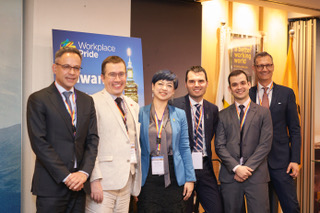
As Workplace Pride’s only in-person event held during the pandemic this year the conference was hosted by EY and ASML in cooperation with NGO’s Hotline Association and Taiwan Equality Campaign. The first section of the conference in Taiwan saw around 80 attendees gathering for targeted workshops and included a panel on diplomatic channels of influence with LGBTI workplace inclusion. This was followed by a globally streamed event featuring various high level speakers including:
Audrey Tang, Taiwan’s Digital Minister)
Moriaki Kida, EY Japan Regional COO)
Ching-Yi Lin, (Taiwan’s Ambassador-at-large.
Peter Bailliere, ASML EVP for HR&O
Hsing-Hsing Chen, Taiwan’s Representative to the Netherlands
Personal and human stories were shared, along with breakout sessions for physical attendees to connect, share and evolve their understanding of the issues facing Taiwan and workplace inclusion for the LGBTI community at present and going into the future.
Hsin-Hsin Chen, Taiwan’s Representative to the Netherlands was present in Workplace Pride’s Amsterdam studio with David Pollard (Exec. Director of Workplace Pride) for the latter section of the conference which was being held online for viewers world-wide.
To see the video of this ground-breaking conference clickHERE
Sean Du and Mei Ying, Hotline Association
“Since same sex marriage was legalized in Taiwan, more and more companies have started to pay attention to LGBTI+ inclusion in the workplace.
This conference provided an opportunity for participants to understand why LGBTI+ inclusion is important, and to learn from the thoughts and experiences of diplomats and representatives in both corporate and NGO’s on workplace equality. It also provided a platform for participants from corporates, NGO’s and governments to connect with each other. For the issues going forward, we need to think about how NGOs, corporates and governments could work together systematically on the topics. We need to let more LGBTI+ community members understand that it’s their right to work in a place that is LGBTI+ inclusive. We also need to think about how to include more local business to work with us.”
Andrew Fuh, EY Taiwan Country Managing Partner
“As the executive sponsor of our LGBT+ network, it was a pleasure for EY to host Workplace Pride with ASML in showcasing both the progress Taiwan has made around containing Covid-19 in being able to have an in-person event and progress around marriage equality as eloquently summarized by minister and ambassador Audrey Tang and Lin Ching-yi. The conference provided a platform for multinational and local companies to discuss ways to implement LGBT+ friendly policies in bringing out the best of our talent and building a better working world. EY is fortunate to be one of the handful of companies that signed the marriage equality statement to encourage both the legislature and government to legalize same sex marriage in 2018, and again in 2019. Through Workplace Pride, we are confident more like minded organizations will join hands as game changers in advancing LGBT+ equality from Taiwan to the rest of Asia, improving the lives of LGBT people at work and in greater society.”
Michiel Kolman, Co-Chair of Workplace Pride
“The Workplace Pride conference was well attended with representatives of major companies, civil society, the diplomatic corps who all engaged enthusiastically in the main program, and especially in the break-out workshops. What was well represented in the program and through the participants, was the role diplomacy plays to support marriage equality and LGBTI human rights. What is a clear next step here is to put exactly that on the diplomatic agenda outside Taiwan and while the Taiwanese Foreign Ministry was saluted for the work they have done so far, there were also clear calls to do more in this area.
Another clear theme was that the legal side might have been well addressed, e.g. through marriage equality, but that doesn’t translate to an immediate effect on work culture, and the acceptance and support for the LGBTI community in the workplace. It was significant that international companies hosted the conference and also the participants came mostly from multinationals. Taiwanese companies, neither large nor small, were present, and that is something that should be changed over time. This conference can very well be seen as a call to action, perhaps even reflected in a ‘Declaration of Taipei’ with the objective to expand marriage equality around the region and actively promote LGBTI workplace inclusion in Taiwan itself, at companies of all sizes. An objective that will require active support from leading companies, civil society, the government including the diplomatic service. More to come for certain!”
Thanks to all contributors from Hotline Association, EY and Workplace Pride
Published 8th of December 2020
Trans re-integration in the workplace Webinar Recap
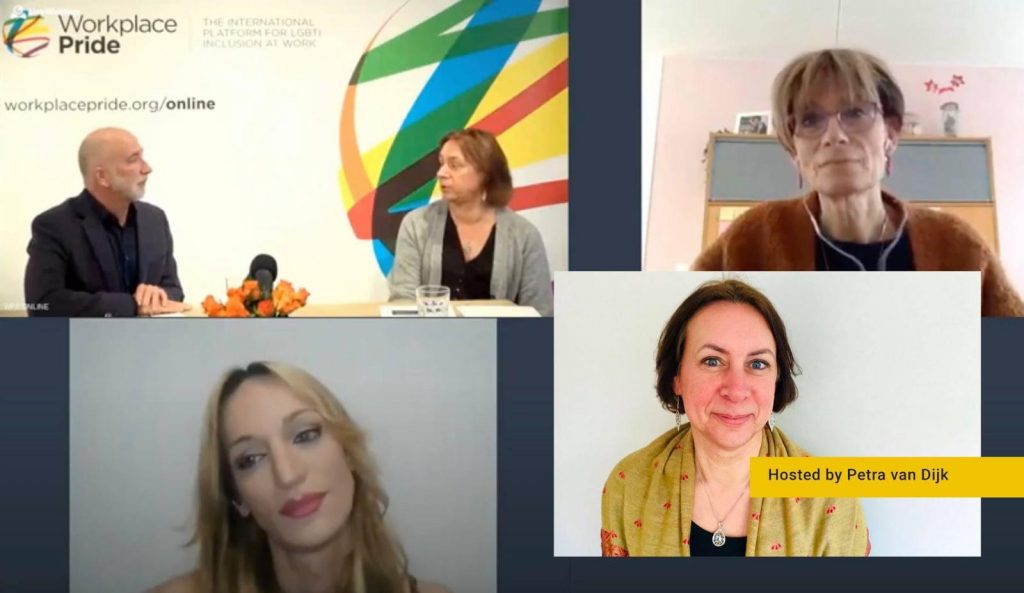
In our latest webinar in the Keeping Members Connected series, Workplace Pride hosted Petra van Dijk from Transwerkt Nederland along with Remke Verdegem of TNN (Transgender Network Nederland. We also had a guest dial in all the way from Argentina, Maryanne Lettieri of Contrata Trans.
Firstly, Petra introduced Transwerkt Nederland and explained what and how her organisation assists trans people with, at numerous stages of their working lives and careers. Unilever for example in the Netherlands is uniquely pioneering forward by having a gender transition policy. Such essential policies are something Petra is very passionate about going forward.
Remke talked about her work with TNN explaining some of the statistics around trans people in the Netherlands and how the binary generation is being succeeded by the “gender fluid” generation.
Since both Transwerkt Nederland and TNN are based in the Netherlands, Maryanne from Contrata Trans brought an international focus on the issues of trans people in Argentina. Maryanne talked about socio-economic plight of trans people and how they are marginalised and are often forced through adversity into the sex industry there.
As always, we had a live international audience who contributed great questions to our fascinating panel!
Timestamps (click the red timestamp to jump straight to that part of the webinar) 0:00 Introduction by David Pollard
1:45 Panel introductions (Petra, Remke and Maryanne)
Government Ministries, Major Multinationals and Civil Society Move the Dial in LGBTI Work-place Inclusion Conference
“Taiwan – Trailblazing LGBTI Workplace Inclusion in Asia” is the title of this unique conference bringing together different stakeholders in a bi-national and multi-media event. With the sub-title: Marriage equality in times of social change”, the timely gathering is being organised against the backdrop of ever greater diverse and inclusive societies and workplaces.
Same-sex marriage is now a fact in Taiwan. This has direct implications for employers and the country as a whole when it comes to the impact on workplaces. But are workplaces prepared when it comes to employee benefits, interaction with their markets/customers, and how marriage equality will effect recruitment and retention? Will married LGBTI employees feel comfortable to be themselves and how do employers prepare their organisation for the overall trend of greater diversity and inclusion that is increasingly prevalent around the world?
As the first country in Asia to implement marriage equality, Taiwan has both a great responsibility to get its impact on LGBTI workplace inclusion right and a great opportunity to set the tone in the region for years to come. And now, within the context of social and geo-political changes sur-rounding the global pandemic, the leadership role for Taiwan is even more needed.
“Forward thinking employers realise that marriage equality in Taiwan will require a different ap-proach to interaction with employees, clients and society”. Says Michiel Kolman, Co-Chair of Workplace Pride and speaker at the event, “This conference brings all stakeholders together and will set the tone for workplace diversity and inclusion in Asia for years to come”.
Top speakers include:
• Audrey Tang, Taiwan’s Digital Minster • Moriaki Kida, EY Regional COO • Peter Bailliere, ASML EVP HR&O • Ching-Yi Lin, Taiwan’s Ambassador-at-large • Hsin-Hsin Chen, Taiwan’s Representative to the Netherlands • Guido Tielman, Representative, Netherlands Office Taipei
Digital Minister for Taiwan Audrey Tang
This landmark event was recorded. Please clickHEREto see the video.
The conference is free to registered participants and consists of both in-person (in Taipei) and live streaming elements (globally). It is being organised by Workplace Pride and is co-hosted by EY and ASML. Civil Society partners include Taiwan Equality Campaign and Hotline Association.
Editor’s Note: For more information regarding Workplace Pride contact: Workplace Pride Executive, Director David Pollard: Tel. +31 (0) 634 056604 e-mail: david@workplacepride.org
Workplace Pride Foundation is the international platform dedicated to improving the lives of LGBTI people in workplaces around the globe. Initiated in 2006, its more than 70 members employ millions of people in almost every country in the world.
Coming out day 2020: a call for awareness and dialogue!
Coming out is a pivotal moment and process for nearly everyone in our community. Whether you to choose to come out or not, this is a day to inspire you to think about the profound importance of being yourself.
For those that take this brave decision, it can bring out an authenticity and honesty to themselves, positively affecting potentially all aspects of life from the home to the workplace and beyond.
Workplace Pride is delighted to celebrate this years Coming Out Day with an excellent article written by Joris Hoekstra who currently works at Deloitte.
Coming Out Day 2020: a call for awareness and dialogue
I used to feel uncomfortable with Pride and Coming Out Day. Extravagant men in weird outfits on a boat. What image would that give us? And a special day to come out of the closet. Why on earth is that necessary? These days I see a tremendous value and necessity for events like these and with this message I would like to address the role we can play as employers and as individuals.
Joris Hoekstra
The bitter and absolute necessity
Previously I was insufficiently aware of the (sometimes lifelong) struggle that LGBT people in The Netherlands and other countries have to cope with. I was insufficiently aware of the fact that in The Netherlands it was since 1994 that a General Equal Treatment Act was realized and that gay marriage was possible only since 2001. I was insufficiently aware of the internalized homophobia, shame, hyper-self-awareness and overcompensation to be loved and accepted (after learning that who you are is bad or at least deviant) that many gays and myself have to deal with. Let alone the higher rate of mental health problems, addiction and suicide among LGBT people.
Fortunately, there are also positive developments such as the much greater extent to which schools educate their students and create awareness for inclusion and events like Coming Out Day. Not too long ago when I was in high school there was no education or guidance at all. Employers are also increasingly taking their responsibility. I would like to elaborate on this.
Inclusive working environment
In my view, employers play a crucial role when it comes to creating inclusion. After all, most people spend most of their week on school or work. Studies show that a positive school or work climate contributes 82% to a feeling of belonging as a LGBT. Employers are increasingly doing their best to create a safe working environment regardless of cultural background, gender, religion and sexual preference. This often manifests itself in facilitating diversity networks, participating in events such like Pride and Coming Out Day to create visibility. Of course this has a positive effect on the employer brand and their ability to attract a diverse and high-performing workforce, but in my view it has an even bigger impact than simple window dressing. Not only do employers send a message to their employees that they value a safe and inclusive working environment, they also send a clear and important message to other organizations and governments (even internationally). In my view, the support of large international organizations is of unprecedented importance.
I am fortunate that both my previous employer Rabobank and my current employer Deloitte (as well as the client relationships I have worked for) make a strong effort to create and radiate an inclusive work environment. For example, two years ago I was on a Deloitte Pride boat and throughout the year I experienced that my employer really makes an effort to create an inclusive environment and enables us to be our authentic selves.
Daily challenges and dialogue
Nevertheless, I also want to reflect on the challenges that I and many others might have in daily life. In addition to social challenges (I am still very reluctant to show affection in public towards my boyfriend, often dream about incidents of discrimination and violence and I carefully choose my holiday destinations ) there are also challenges in the working environment. What do you do if you are offered an assignment in a country where your sexual orientation is against the law? Do you dare to be yourself in a boardroom setting (which often still consists of middle-aged white men)? Do you mention you have a boyfriend and would that influence your career? How do you deal with a quiz at a team event where all the questions focus on having a partner of the opposite sex, leaving you the only one who can’t participate? How do you deal with invitations or conversations assuming you have a girlfriend? Does your male colleague feel uncomfortable sharing a room with you? And can you be yourself towards international colleagues and client relations from countries where homosexuality is rejected or even illegal?
There are many more examples and they all have one thing in common: having a dialogue about it leads to more awareness, understanding and connection. I have experienced that discussing uncomfortable and challenging situations in the working environment always results in an open conversation, confirmation of the positive intentions of the other and deepening of the relationship. And ultimately increase the feeling of belonging, of inclusion. I encourage everyone to have a dialogue about this and in this way to take responsibility for a healthy, inclusive and above all a pleasant working environment.
Grateful call for dialogue
I myself am very grateful that my parents accepted me for who I am, that I have loving friends and colleagues, that I have a loving relationship in which vulnerability around this subject is possible, and that I live in a country that is relatively safe and inclusive for LGBT. At the same time I see many people in both The Netherlands and abroad struggle and suffer. I want to emphasize once again the importance of creating awareness. Every day in your life, in the workplace and on specific days like today.
In a time when having dialogues and celebrating special days are a little different from normal, I hope more than ever that this day will contribute to the safety and inclusion that we all deserve. Celebrate this day with me!
Top Scorers in Annual LGBTI Global Benchmark Show Cross Sector Progress
Workplace Pride publishes 2020 results measuring inclusion among employers
The spotlight for Workplace Pride’s 2020 annual Global Benchmark goes to those organisations whose outstanding performance indicate true milestones for LGBTI inclusion in the workplace. It is encouraging that exceptional progress is being made in many different sectors; progress that allows LGBTI employees to ‘truly be themselves’, no matter where in the world they are. Top performers include:
Most Improved Private Sector over 2019 Global Benchmark score: RELX/Elsevier: + 32.6%
Most Improved Public Sector over 2019 Global Benchmark score:Saxion University of Applied Sciences: + 26.6%
Highest Starting position for a new participant:Netherlands Ministry of Finance
Special “Hall of Fame” award as 1st organisation to reach 100% on the Global Benchmark: IBM
Special recognition also goes to those organisations that have each scored higher than 90% on the Workplace Pride Global Benchmark survey. Receiving the title of “Advocate”, these organisations are breaking new ground for LGBTI inclusion in their activities around the world and setting the tone for change beyond the workplace in society at large.
ADVOCATES for the 2020 Global Benchmark include:
Accenture
Deloitte
Dow Inc.
IBM
RELX/Elsevier
Royal Dutch Shell
Sodexo
Scoring between 89.9% and 60%, from among the nearly 40 participants this year, the “Ambassadors” show excellent achievement in their ongoing leadership in driving progress for LGBTI workplace inclusion and act as role models for others.
AMBASSADORS for the 2020 Global Benchmark include:
ABN AMRO
Aegon
Arcadis
ING
NautaDutilh
Netherlands Ministry of Foreign Affairs
Nokia
Philips
PwC
“Organisations participating in the 2020 Global Benchmark represent millions of employees in over 100 countries worldwide and we applaud their engagement!” said David Pollard, Executive Director, Workplace Pride. “Particularly in these very challenging times for everyone, these employers are in a unique position to influence cultural change not just within their own walls, but also with governments and in the communities and countries in which they operate”.
The Workplace Pride Global Benchmark was first released in 2014 as an annually recurring survey that allows participants to track their progress. It has been developed under the leadership of Workplace Pride and with the support of the University of Leiden and major employers and NGOs from several different countries.
The Benchmark represents the ideal of LGBTI workplace inclusion around the world and is designed to provide management the data to measure, and thereby improve, LGBT workplace inclusion in their organisations, wherever they are. Each participating organisation receives a detailed overview of their progress broken down into the following 8 categories: Policy and Communication, Employee Networks, Workplace Awareness, Support & Benefits, Inclusion and Engagement, Expertise & Monitoring, Business and Supplier Engagement, Impact on Society
Workplace Pride Members
Editor’s Note: For more information regarding Workplace Pride contact: Workplace Pride Executive Director David Pollard: Tel. +31 (0) 634 056604 e-mail: david@workplacepride.org
Workplace Pride Foundation is the international platform dedicated to improving the lives of LGBTI people in workplaces around the globe. Initiated in 2006, its more than 70 members employ millions of people in almost every country in the world.
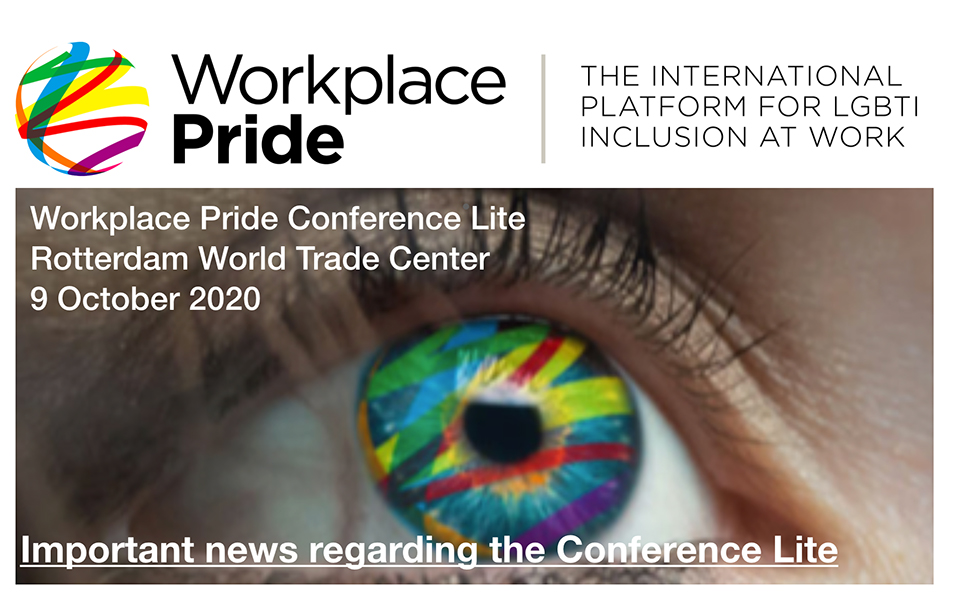
In light of this weeks official announcements regarding the escalation of the COVID-19 situation and subsequent effects on social gatherings, distancing and travel, it is with deep regret that we have to make the logical decision to cancel the Conference Lite event at the WTC in Rotterdam on the 9th of October.
Everyone at Workplace Pride is indeed sad that our leaders, partners and members won’t have this much needed opportunity that the conference would afford them to discuss the shifting tides of LGBTI diversity and inclusion in the workplace, especially during the ongoing global pandemic at this stage.
Despite the cancellation of the conference, Workplace Pride will continue adapting to our members needs as we diversify our support strategies in keeping with our evolution this year with our Keeping Members Connected webinars and the New Horizons magazine.
From us all at Workplace Pride we hope you are staying safe and we look forward to a future of forging new opportunities to connect and strengthen LGBTI inclusivity and diversity in workplaces worldwide!
Warm regards,
David Pollard Executive Director Workplace Pride Foundation
From left to right: Kevin Kabatsi, Cheyenne Smaal, Aurora Guds, Winsten van Niel
With a live international audience of over 100 participants, four unique voices of LGBTI people of colour shared their passion, professionalism and humanity as they discussed the hard issues facing their community in workplaces around the globe.
Cheyenne Smaal: A successful coaching executive at Waternet,
Cheyenne is a Hindustani Surinamese transgender person who has struggled through cultural
taboos and turned them into positive methods of transformation
Winston van Niel (Moderator): Founder of Parea Nederland, which is a growing network of LGBTQ+ professionals of colour, Winston is also a consultant in SME funds management in relation to the public sector.
Aurora Guds: Employed at the Dutch Ministry of Finance and a Board Member of their LGBTI network, ‘B/Proud’, Aurora seeks to embolden and further workplace inclusion for LGBTI people of colour.
Kevin Kabatsi: Originally from Uganda where discrimination was compounded by race and sexuality. Kevin moved to the Netherlands to find a better life and study. He is now the Program Manager for Africa at the Rabobank Foundation.
Moderated by Winston, the webinar was split into two main sections plus a Q&A. In the first section, Winston and the panel shared candid stories about their personal experiences in the workplace along with their biggest challenges around the issues that LGBTI people of colour face in 2020.
Part two of the discussion focused on workplace policies and structures. The panel discussed
their thoughts on gender equality, D&I interventions and LGBTQ equality. Best practices and practical pieces of advice based on their own experiences provided the audience with a valuable
opportunity to ask questions to the panel in a very lively and insightful Q&A section.
The topic of academia and the inherent challenges for LGBTI persons studying or working within its many layers, is an area sorely in need of attention and discussion.
To officially launch this historic new program, Workplace Pride hosted an inaugural event in the form of a live webinar, hosted by one of the new co chairs of Workplace Pride, Dr. Michiel Kolman on August 24th 2020.
In response to the increase in the number of academic institutions who are now members of Workplace Pride and the fact that LGBTI workplace inclusion is a topic that runs deep through all levels of academia, Workplace Pride has decided to augment its current list of programs to include academia alongside current programs for women, technology and younger people.
Lyle Muns, the chair of LSvb brought a student-oriented and activistic perspective to the discussion.
The Workplace Pride chair for workplace inclusion at Leiden University, Prof. Jojanneke van der Toorn brought her insights as an ally using her body of research and an evidence-based approach to the discussion.
Professor Annetje Ottow is currently Vice-President of Utrecht University and she shared her thoughts on academic institutions and the challenges therein of improving inclusion and visibility of the LGBTI community.
“At this pivotal moment of social awareness in the world, it is refreshing to see academia engage in the crucial topic of LGBTI inclusion”, said David Pollard, Exec. Director of Workplace Pride, “ By providing a platform for our new Academia@WorkplacePride program, we hope to stimulate conversation and debate, and, most importantly, improve the working environment for LGBTI students, staff and faculty in higher education and research institutions”.
Being transgender in the workplace has always come with significant challenges. Whether this is the communication process with your colleagues, arranging leave for medical procedures, or the sheer uniqueness of a person’s transition for the organisation, it can be both daunting and frustrating.
Now, however, there is a new agency ‘Transwerkt Nederland’ (Trans Works Netherlands) which facilitates this process for both the person transitioning and the organisation through an integral approach putting the transitioning person in the middle point. As an initiative of the well established re-integration bureau “Job Coach Connect”, and at the request of Workplace Pride member UWV and civil society organisation TNN (Transgender Network Netherlands), this initiative has huge potential for both the transgender community and their employers.
In the article below, Petra van Dijk of Transwerkt Nederland tells her own story and relates how the tide has turned for the better for transgender people in Netherlands’ workplaces.
Later this fall, Workplace Pride office will be hosting a webinar with Transwerkt Nederland and dive into more detail about the complex issue of being transgender in the workplace.
Trans Werkt Nederland Supports Transgender People
About a year ago, a re-integration agency called Jobcoach Connect, was invited by Workplace Pride member, UWV and TNN (Transgender Network Netherlands) to tackle the low employment rate of transgender people in The Netherlands, through guidance and job coaching. This new initiative is called ‘Trans Werkt Nederland’ (Trans Works Netherlands)
From a study conducted in 2017, we learned that almost 20% of transgender people are unemployed or incapacitated and that 28% have a net income of less than €1.000 per month, despite 41% of them being well educated.
As a qualified job-coach and a experiential transgender woman, I think I can make a difference when it comes to empowering trans people. Be it helping them find work or to resolving challenges in their workplaces. I recently joined Trans Werkt Nederland because I think it’s important that the talent of transgender people is not wasted and that transgender people can function perfectly just like any other employee.
A lot of improvements still have to be made for LGBTQI+ people in the workplace. Recently, a consultancy organization called ‘Berenschot’ conducted a survey that showed that only 20% of Dutch companies have an active diversity policy. Another survey by IT service provider ‘Peak-IT’ showed that 20% of the supervisors and HRM managers are hesitant to hire a transgender person!
These times are very challenging. We’ve had the #metoo discussion, and the horrible death of George Floyd that outraged the world. The #blacklivesmatter movement demands the end the discrimination of people of color and ending institutionalized racism.
In the midst of all this, we have the COVID-19 pandemic. Millions of people all over the world are infected, many getting sick. Lots of companies struggle: less work, employees working at home, decisions made on whether to continue with providing government support or letting people go or maybe even going bankrupt. Many are unemployed as a result, often being the most vulnerable with flexible or temporary contracts, young people working in the catering industry and the self-employed.
Recent developments in Hungary and Poland show that some European countries are not being progressive in their legislation for the LGBTQI+ community.
The recent ILGA Rainbow Index shows no progress for the LGBTQI+ situation in Europe.
However, I personally feel that times are slowly changing overall for the better for LGBTQI+ people. But at the same time I realize that I am very privileged as a Dutch, white, well-educated trans woman with a strong character and lots of support in my life. I know that many trans people are struggling, even in The Netherlands. Especially trans people of color, religious trans persons and sex-workers.
This website uses cookies to improve your experience. We'll assume you're ok with this, but you can opt-out if you wish. Cookie settingsACCEPT
Privacy & Cookies Policy
Privacy Overview
This website uses cookies to improve your experience while you navigate through the website. Out of these cookies, the cookies that are categorized as necessary are stored on your browser as they are essential for the working of basic functionalities of the website. We also use third-party cookies that help us analyze and understand how you use this website. These cookies will be stored in your browser only with your consent. You also have the option to opt-out of these cookies. But opting out of some of these cookies may have an effect on your browsing experience.
Necessary cookies are absolutely essential for the website to function properly. This category only includes cookies that ensures basic functionalities and security features of the website. These cookies do not store any personal information.
Any cookies that may not be particularly necessary for the website to function and is used specifically to collect user personal data via analytics, ads, other embedded contents are termed as non-necessary cookies. It is mandatory to procure user consent prior to running these cookies on your website.