2022 Pride Week Recap

Workplace Pride held three wonderful events for our members and other stakeholders during this year’s Amsterdam Pride.

Workplace Pride was pleased to have an ‘Open House’ reception for our members on July 28th at our new office. With a larger office, the Foundation can now organise more events and activities, even on behalf of our members! The well-attended open house was the first large event in our new office! We enjoyed plenty of refreshments and appreciated the opportunity to connect with old and new members alike.  This was a fantastic evening that made our office truly feel like our new home.  We look forward to more “gezelligheid” in the future!


On Saturday July 30th, a large delegation of almost 100 people from Workplace Pride members came together during the 2022 Amsterdam Pride Walk. This powerful event captured the importance of LGBTIQ+ inclusion and being your authentic self.

As a precursor to the walk, Workplace Pride organised a breakfast reception to ensuring plenty of energy for the walk ahead. The group was joined by a magnificent Samba band which provided a great focal point and helped us to celebrate Pride in a festive way. 

A remarkable moment of the walk was when our group entered the main entrance of Vondelpark and were greeted by the 71 flag carriers of the Zero Flag Project. Each carrier was holding a national flag representing countries in which homosexuality is criminalised or even punishable by death. This was a compelling and sobering reminder that we are in this fight together and why it is so important for us to be loud and proud as a community.


Last but certainly not least, Workplace Pride was honoured to organise the 2022 edition of ‘Stories From the Heart’, kindly hosted by our Foundation Member, Heineken, and co-hosted by our Foundation Partner PwC. As many Workplace Pride members have activities in locations where it is difficult or even dangerous to be openly LGBTIQ+, this event, now in its third year, provided our members a first-hand account of what their colleagues and other community members experience on a regular basis. This year’s event featured activists from Kazakhstan, Azerbaijan, Kyrgyzstan, Poland, Slovakia, Serbia, Hungary. Stories From the Heart is a joint initiative of Workplace Pride, the Netherlands Ministry of Foreign Affairs and the RVO (the Netherlands Enterprise Agency) in partnership with the COC Nederland and the Municipality of Amsterdam. 

Our heartfelt thanks to our all of our members who attended our events, or who participated in Pride in their own way in celebration of the LGBTIQ+ community.

“Not every Pride sponsor engages in ‘Pink Washing’”

As 2022 Pride week in Amsterdam continues, it is important to stop and take stock of the ongoing controversy surrounding ‘Pink Washing’ and the impact this has on both business and the LGBT community. The following article, which does just that, was published in the main financial newspaper in the Netherlands, the ‘Financial Dagblad’. Authors, Boris Dittrich and Michiel Kolman are a Workplace Pride Advisory Board Member and Co-Chair respectively. 

For the Dutch translation scroll down. 

Not every Pride sponsor engages in ‘pinkwashing’

Boris Dittrich, Michiel Kolman 2 Aug 16:30 Financieel Dagblad 

A critical look at companies that deal opportunistically with Pride is urgently needed. But the pendulum is now swinging too much in the direction of sidelining companies. The queer community does not benefit from this, write Boris Dittrich and Michiel Kolman in their opinion piece.

In recent years criticism of Pride sponsors has become a regular feature of Pride Month. Not surprising, because everyone knows the examples of commercial parties that once a year beat the drum about the inclusion of LGBT people, but meanwhile do little to support the community throughout the year. Last year the Amsterdam convention center RAI proudly announced that it would be raising the rainbow flag, but the RAI wanted to see no less than 5000 euros when the organizers of the Pride Walk wanted to start in its parking lot. ‘Talk about pinkwashing,’ the justifiably angry Pride organization responded.

Partly because of incidents like this, criticism seems to have increased in the last couple of years. Some commentators wonder aloud whether the queer community should get involved with companies like PWC and Deloitte; while they might create a good impression with their sponsorships they serve in fact commercial interests and are also thought to support tax avoidance. A critical look at parties who deal opportunistically with the Pride is badly needed, but the pendulum is now swinging too much in the direction of completely sidelining the business community. This does not benefit the queer community. 

We must remember that the vast majority of Pride sponsors take their role in inclusion very seriously. Recent research showed that 80 percent of the sponsors have active policies on LGBT inclusion in place. For instance, transition leave for transgender people is part of the HR policies, but also smaller but no less important steps such as the introduction of All Gender toilets or guidelines for inclusive language in the workplace. Supporting the Pride groups within the organization with time and budget is also an important pillar of a successful inclusion policy.

These inclusive policies are definitely necessary, as research (by the SCP) has shown that as many as 36 percent of LGBT people in the Netherlands experience discrimination in the workplace, from discriminatory jokes to sexual harassment. This shocking figure has enormous consequences: of the LGBT people who experience discrimination, 7 percent look for another job or stop working altogether. Recent research has also shown that a quarter of the LGBT staff who are out of the closet at work sometimes still choose to conceal their sexual orientation, for example in conversations about their private lives. Moreover, 26 percent of LGBT people view coming out at work as a disadvantage, e.g. for career opportunities. And 55+ LGBT people are twice as likely to be disabled than heterosexuals, have more burnouts, and are less satisfied with their work. 

There is a major social problem here, and employers who take their role in this seriously are having significant impact on a large group of LGBT people. The aforementioned and maligned companies PWC and Deloitte are precisely examples of how to successfully work on inclusion. They score very well on the various aspects, such as support for Pride groups, internal monitoring of LGBT inclusion – for example with surveys – and implementing concrete policies for LGBT people, such as including regulations in the collective bargaining agreement.

In the Global Benchmark of the Workplace Pride Foundation, in which organizations are measured annually on the state of LGBT inclusion in their workplace, PWC and Deloitte have excellent scores. We also know from research that visibility and public support is an important component of how inclusion is experienced.

Anyone who wants to exclude these types of companies from Pride is throwing the baby out with the bathwater and in doing so harms not only LGBT people but also the innovative power of Amsterdam. The recent Open for Business report shows that LGBT-inclusive cities do better in terms of economic innovation and employment. Amsterdam tops the list for the second time in a row, and businesses play an important role in creating this inclusive and innovative climate.

Commercial parties that play a serious, positive role should be further encouraged to do so. Of course this involves much more than the annual hoisting of the rainbow flag or a boat in the canal pride. A structural approach to LGBT inclusion is needed throughout the year. 

But what does such an approach look like? As is always the case with complex problems, there is no quick fix. Structural attention to employee identities is needed. This starts with recognizing and identifying the additional challenges for LGBT people within the organization. This sounds abstract, but fortunately, there are practical tools for companies who want to get started. Workplace Pride’s Global Benchmark and HRC’s Corporate Equality Index are examples of how to measure an organization’s performance in the area of LGBT workplace inclusion. Such benchmarks, which also address pain points for the organization, are an important first step in establishing an LGBT inclusion policy throughout the organization. 

We must strive to broaden rather than narrow the struggle for inclusion, equal rights, and non-discrimination. That means we need allies and not just from the LGBT community itself. Let’s keep our eyes on the ball – together we are stronger.

Boris Dittrich, member advisory board Workplace Pride Foundation
Michiel Kolman, co-chairman of Workplace Pride foundation and senior VP at Elsevier

https://fd.nl/opinie/1447252/niet-elke-pride-sponsor-doet-aan-pinkwashing-qbh2ca84xRxB

—————————————————————————————————-

OPINIE

Niet elke Pride-sponsor doet aan ‘pinkwashing’

Boris Dittrich Michiel Kolman 16:30

Kritisch kijken naar bedrijven die opportunistisch omgaan met de Pride is hard nodig. Maar de pendule zwaait nu teveel de kant op naar het in de hoek zetten van het bedrijfsleven. De queergemeenschap is daar niet bij gebaat, schrijven Boris Dittrich en Michiel Kolman in hun opiniebijdrage.

Illustratie: Hein de Kort voor Het Financieele Dagblad

De afgelopen jaren is kritiek op sponsoren een vast onderdeel geworden van de Pride-maand. Niet verwonderlijk, want iedereen kent de voorbeelden van commerciële partijen die één keer per jaar op de trom slaan over inclusie van lhbti’ers, maar ondertussen weinig concreets doen om te gemeenschap te steunen. Zo liet de RAI vorig jaar trots weten de regenboogvlag te hijsen, maar wilde het congrescentrum maar liefst €5000 zien toen de organisatie van Pride Walk die demonstratie door Amsterdam vanaf het parkeerterrein van de RAI van start wilde laten gaan. ‘Talk about pinkwashing!’, reageerde de (terecht boze) organisatie.

Mede door dit soort gebeurtenissen zwelt de kritiek verder aan. Sommige commentatoren vragen zich hardop af of de queergemeenschap zich wel met bedrijven als PwC en Deloitte moet inlaten, omdat zij mooie sier maken met sponsoring, maar ondertussen commerciële belangen dienen en betrokken zouden zijn bij belastingontwijking. Kritisch kijken naar partijen die opportunistisch omgaan met de Pride is hard nodig, maar de pendule zwaait nu teveel de kant op van het in de hoek zetten van het bedrijfsleven. De queergemeenschap is daar niet bij gebaat.

We moeten niet vergeten dat verreweg de meeste Pride-sponsoren hun rol bij het inclusievraagstuk zeer serieus nemen. Dit jaar blijkt uit onderzoek dat 80% van hen actief beleid voert voor lhbti-inclusie. Daarbij kan worden gedacht aan het opnemen van transitieverlof voor transgender personen in de cao. Maar ook aan op het oog kleinere, maar niet minder belangrijke stappen als het invoeren van genderneutrale toiletten, of richtlijnen voor inclusief taalgebruik op de werkvloer. Ook het met tijd en budget ondersteunen van de Pridegroepen binnen de organisatie is een belangrijke pijler van succesvol inclusiebeleid.

Beleid is keihard nodig

Dat soort beleid is keihard nodig. Uit onderzoek van het Sociaal en Cultureel Planbureau (SCP) blijkt dat maar liefst 36% van de lhbti’ers in Nederland discriminatie op de werkvloer ervaart. Dit varieert van discriminerende grappen tot seksuele intimidatie. Dit schrikbarende cijfer heeft enorme consequenties: van de lhbti’ers die discriminatie ervaren, zoekt 7% een andere baan of stopt helemaal met werken. Uit recent onderzoek blijkt bovendien dat een kwart van de lhbti’ers die op het werk ‘uit de kast’ is, er op sommige momenten tóch voor kiest de seksuele oriëntatie te verhullen, bijvoorbeeld in gesprekken over het privéleven. In Nederland ziet 26% van de lhbti’ers een coming-out op het werk als een nadeel, onder meer voor de carrièrekansen. En 55+ lhbtiers worden twee keer zo vaak arbeidsongeschikt als hetero’s, hebben meer burnouts en zijn minder tevreden met hun werk.

Er is hier, kortom, sprake van een groot maatschappelijk probleem. Werkgevers die hun rol hierin serieus nemen, maken serieuze positieve impact op een grote groep lhbti’ers. De eerdergenoemde en vermaledijde bedrijven PwC en Deloitte zijn juist voorbeelden van hoe je succesvol aan inclusie werkt. Zij scoren zeer goed op de diverse aspecten, zoals steun voor Pridegroepen, het intern monitoren van de lhbti-inclusie (bijvoorbeeld met enquêtes) en het voeren van concreet beleid voor lhbti’ers, zoals het opnemen van regelingen in de cao.

In de Global Benchmark van stichting Workplace Pride, waarin organisaties jaarlijks doormeten hoe het staat met de lhbti-inclusie op hun werkvloer, scoren deze twee bedrijven uitstekend. Uit onderzoek weten we bovendien dat zichtbaarheid en publieke steun een belangrijk ingrediënt is voor het gevoel van inclusie.

Wie dit soort bedrijven van de Pride wil weren, gooit het kind met het badwater weg. Je schaadt daarmee niet alleen lhbti’ers, maar ook de innovatieve kracht van Amsterdam. Het recente rapport Open for Business toont aan dat lhbti-inclusieve steden het beter doen in economische vernieuwing en werkgelegenheid. Amsterdam prijkt voor het tweede keer op rij bovenaan de lijst, en bedrijven spelen een belangrijke rol in het creëren van dit inclusieve en innovatieve klimaat.

‘Wie dit soort bedrijven van de Pride wil weren, gooit het kind met het badwater weg’

Commerciële partijen die een serieuze, positieve rol spelen moeten daartoe verder worden aangemoedigd. Als vanzelfsprekend komt daar veel meer bij kijken dan het jaarlijkse hijsen van de regenboogvlag of een boot over de grachten varen. Er is het hele jaar een structurele aanpak nodig voor lhbti-inclusie.

Geen quick fix

Maar hoe ziet zo’n aanpak er dan uit? Zoals altijd het geval met complexe vraagstukken, bestaat er geen quick fix. Er is structureel aandacht voor de identiteiten van medewerkers nodig. Dat begint bij het erkennen en in kaart brengen van de extra uitdagingen voor lhbti’ers binnen de organisatie. Klinkt dit u wat abstract? Gelukkig zijn er praktische handvatten voor bedrijven die hiermee aan de slag willen. De Global Benchmark van Workplace Pride en de Corporate Equality Index van HRC zijn voorbeelden van hoe je elk jaar kunt meten hoe goed of slecht je organisatie het doet in lhbti-inclusie op de werkvloer. Meten is weten. Met metingen, waarin ook de pijnpunten voor de organisatie aan bod komen, zet je als bedrijf een belangrijke eerste stap voor een lhbti-inclusiebeleid.

We moeten ernaar streven de strijd voor inclusie, gelijke rechten en non-discriminatie te verbreden, in plaats van te vernauwen. Dat betekent dat we bondgenoten nodig hebben, en niet alleen uit de lhbti-gemeenschap zelf. Laten we onze ogen op de bal houden – samen staan we sterk.

Michiel Kolman is co-voorzitter van stichting Workplace Pride, Boris Dittrich is lid van de adviesraad van deze stichting.

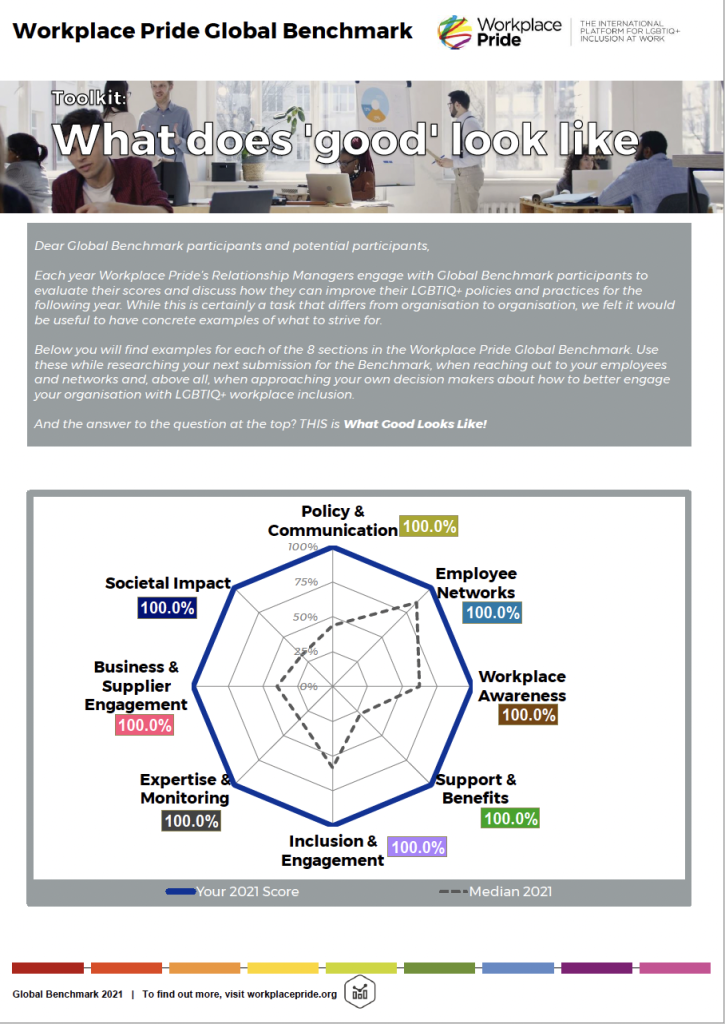
This is what GOOD looks like for LGBTIQ+ workplace inclusion!

July 20th, 2022

The 2022 Global Benchmark is now complete!

All the submissions have been received and evaluated and results have been distributed to participants. 

The top scorers, and in particular those organisations that innovated in the field of LGBTIQ+ workplace inclusion will be announced very soon!

The Global Benchmark has been providing organisations with invaluable insights into workplace inclusion for LGBTIQ+ workforces around the globe going on 9 years now.

The gathered knowledge from the many participating organisations over the years has allowed us to truly define the ‘best in class’, when it comes to this topic. However, to make this, sometimes a complex topic, easier for all to digest, we have created the practical document below.  

The eight sections in the benchmark focus on key areas and metrics, indicating clearly how far an organisation, may have come with its inclusion policies, and indeed where it may need to take them in order to improve or innovate going forward into the new decade. 

With this document in hand, D&I managers, LGBTIQ+ network leads, and anyone who believes in more LGBTIQ+ inclusion in the workplace can give a clear and resounding response to the question: “What does ‘good’ look like for LGBTIQ+ inclusion in the workplace?”.

Please feel free to download the PDF for a full and more detailed explanation.

[wpdm_package id=’11195′]

LGBTIQ+ Employee Resource Groups: Benefits, Challenges, and Opportunities a Symposium at Leiden University

While organizational attention to the topics of workplace equality and inclusion has increased, some social groups are still disadvantaged. To support LGBTIQ+ employees at work, many organizations have LGBTIQ+ employee resource groups (ERGs). These groups are uniquely placed to provide a safe space for LGBTIQ+ employees, facilitate alliances between these employees and their ally colleagues, and advocate for structural changes in the organization.

Jojanneke van der Toorn, Workplace Pride’s Special Professor
for LGBTIQ+ inclusion

In this symposium, Prof. Anna Einarsdottir, from the University of York, and Prof. Jojanneke van der Toorn, from Leiden University and Workplace Pride’s Special Professor for LGBTIQ+ Inclusion, shared insights from their recent research on the topic, discussing the promises and pitfalls of LGBTIQ+ ERGs and how they can be most effective. A panel including LGBTIQ+ ERG and HR specialists, including Workplace Pride’s executive David Pollard, reflected on the findings, shared insights from practice, and discussed how ERGs can contribute to LGBTIQ+ workplace inclusion.

The “LGBTIQ+ Employee Resource Groups: Benefits, Challenges, and Opportunities” symposium was organized by Jojanneke van der Toorn, Eva Jaspers, Chenhao Zhou, Kshitij Mor, and Paula Hoffmann, in collaboration with Academia@WorkplacePride.


* To read the full summary report click below:

[wpdm_package id=’10979′]

  • To watch the video of the symposium, click here
  • To view the slides from the symposium, click below:

[wpdm_package id=’10977′]

Workplace Pride releases the Civil Society Business Toolkit

Workplace Pride, Open for Business and The Other Foundation have co-created the Civil Society Business Toolkit.

The three organisations developed the Civil Society Business Toolkit to provide CSOs with a guide on how to interact with businesses more effectively and productively. It focuses specifically on empowering LGBTIQ+ CSOs, regardless of their experience and background, and has been written to be inclusive of individuals with limited experience in working with corporate and commercial terminology. With concrete examples and real-life suggestions, the Civil Society Business Toolkit is designed to be practical, goal-driven, and sustainable. 

The realms of civil society organisations and businesses around the globe have often been seen as mutually exclusive. In reality, these two worlds have more in common than either may realise. Increasingly, businesses are seeking to address LGBTIQ+ inclusion within their organisations, and CSOs are well placed to advise and support them on their journey. In turn, businesses are able to use their societal and economic influence to amplify the work of LGBTIQ+ CSOs.


The four-part toolkit covers:

  • Aligning your aspirations with your prospective business partners’ objectives
  • How to summarise the business case for LGBTIQ+ inclusion
  • Eight practical tools to help improve collaboration with business partners
  • How to develop intentions into actions that will advance LGBTIQ+ inclusion in both the workplace and society 

The Civil Society Business Toolkit has come at the right time. CSOs have been expressing the need to have tools to help them engage with businesses for a number of years. Businesses need to bring in the experts to help with their inclusivity journey and they can’t do that work in isolation. The toolkit will help CSOs be those experts for business. CSO need to be ready to take on the ability to speak strategically, understand resources and resource constraints, and understand the politics of a business.  This is why collaborative efforts are so important.’

Sebenzile Nkambule
Executive Officer for Strategic Partnerships at the Other Foundation

The coalition would like to thank the Global Equality Fund which initiated and financially supported this work. 

You can download the Civil Society Toolkit and read case studies from CSOs here


Civil Society Business Toolkit: A two-way street to LGBT+ progress:

Download the PRESS RELEASE here:

[wpdm_package id=’10951′]

Dubai: A Vision for Diversity & Workplace Inclusion

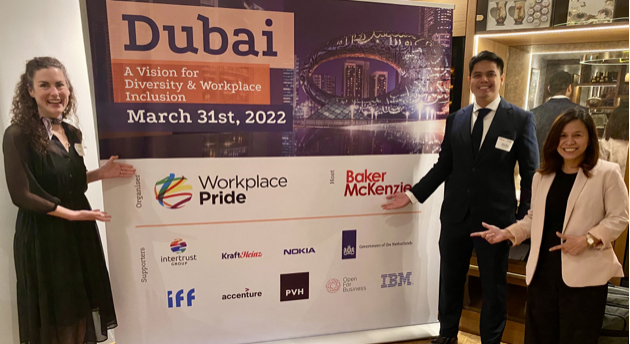
Historic’, ‘milestone event’ and ‘groundbreaking for the region’ were some of the terms used to describe the “DUBAI: A Vision for Diversity and Workplace Inclusion” conference which took place on Thursday, March 31st. This well-attended event was organised by Workplace Pride Foundation and hosted by Baker McKenzie. Participants were primarily businesses, both Workplace Pride members active in the region and Baker McKenzie’s clients as well as contacts from The Netherlands embassy in the UAE. The Embassy also hosted an opening reception for the event on March 30th in their extraordinary Expo 2020 Dubai pavilion. 

Dubai, the setting for the conference and one of 7 Emirates in the United Arab Emirates (UAE) is in the very unique position of being at the crossroads of the modern world, both geographically and economically. In fact, many Workplace Pride members have offices or activities in the UAE that cover the entire Middle East and often Africa as well. In addition to this, Dubai was chosen as the venue for the conference to leverage Expo 2020 which brought representatives from around the world to the emirate and offered a rare opportunity to highlight Dubai’s role as an agent of change. This role as a change-maker also rings true when it comes to introducing more diversity and inclusion (D&I) in the Middle East and in the global hub that Dubai has become.

The conference addressed Diversity and Inclusion barriers as well as the opportunities facing businesses in Dubai and the wider region in regards to their workforces, their clients/customers and their suppliers in the region. It covered all aspects of D&I and zoomed in on how these tie into corporations’ global goals and policies. It also explored how international investors look increasingly at the breadth of a businesses’ engagement when it comes to equitable workplaces and the impact this has on decision-making. 

Highlights of the event included: 

  • Opening Reception hosted by Douwe Buzeman, Deputy Ambassador of The Netherlands Embassy on March 30th in their extraordinary Expo 2020 Dubai pavilion
  • Opening Conference address by Hani Naja, Partner at Baker McKenzie, Dubai
  • A context-setting video featuring Walid Hadi, Shell
  • Panels on: 
    • “Diversity, Inclusion, and Equality: no longer a luxury for global businesses” moderated by David Pollard, Exec. Director, Workplace Pride with panelist: 
    • Tamer Zikry: Global Head of Talent, Diversity & Inclusion, Intertrust Group
    • Nassib Abou-Khalil: Chief Legal Officer, Nokia 
    • TJ Lightwala: Managing Director, Experience Services Lead, MENA, Accenture
  • “Diplomacy as a Tool for Progress” moderated by Michiel Kolman, Co-Chair Workplace Pride with panelist:
  • Anne-Roos Wasser: Senior Policy AdvisorNetherlands Ministry of Foreign Affairs
  • Alison Hall: Deputy Consul General, UK Consulate Dubai
  • “Future stakeholders for the new way of working” moderated by Bianca Nijhof, Co-Chair Workplace Pride with panelist:
  • Abeer Jarrar: Representative BakerWomen, Corporate Partner Baker McKenzie Dubai
  • Reema Haddad: Head of HR D&I Leader Middle East & Africa at IBM

    Additional presentations were made by: 
  • Mirjam de Blecourt: Principal at Baker McKenzie, Amsterdam & Member the Netherland’s Senate
  • George Perlov: Acting Exec. Director, Open for Business

In the closing address, Kitty van der Heijden: Director-General International Cooperation, Netherlands Ministry of Foreign Affairs eloquently brought all of the themes of the day together in a way that demonstrated the great opportunity that D&I presents to both Dubai and all corporates that operate there. 

This important milestone event will also leave a legacy in the form of a new network of D&I professionals and supporters in Dubai that will meet on a regular basis, starting with a first gathering hosted by Accenture. (For more information on this effort, contact david@workplacepride.org

Workplace Pride would like to thank Baker McKenzie, The Netherlands Ministry of Foreign Affairs and all of our supporting member organisations that helped to make this event possible. 

For more information about Workplace Pride, write to info@workplacepride.org

22 March 2022

We held our first Member Exchange Session on March 15 on the topic of Creating a Transgender Policy, and we would like all our members to have access to what we learned from this session, here are the most important metrics, takeaways, and the link to the recording of the session.

  • 42 people attended
  • >80% of attendees joined to learn
  • >60% of respondents either have no Trans policy or are just getting started
  • 96% of respondents learned something that will help them and found the session a good use of their time.

Key takeaways:

  • Get sponsorship from the top – it’s “good to have HR or DEI officer intrinsically motivated” so that they be visible in their support and help you get the time and resources needed. Research shows that 1.2% – 1.5% of the population is transgender – even if no one has come out in your org, data says that they are likely there but in the closet.

  • Learn what is needed and educate your stakeholders – “don’t assume you know”, connect with the Trans community in your org or with a Trans CSO/organization to learn (Workplace Pride L&D, Corporate Queer, Transvisie as NL examples).  Let ERG educate the business about what is needed and why. Create a guiding document that helps everyone understand what is needed to support Trans people in the workplace.

  • Make it practical and take concrete steps – taking on a whole policy may be daunting, focus on smaller steps like “what it needed to change gender and name in IT systems” or “get the required medical procedures for transitioning added to health insurance benefits – either private or government depending on location”. 

  • Location/region-specific assessments – looking at what medical and health benefits are covered will differ by location.  What you as an organization need to do will depend on how much is already covered by the government or social structures in a location. There is no known resource of which countries/locations cover which aspects, you will need to do that work with your local Benefits team. 

A link to the meeting recording is here: Recording: Member Exchange Session – Transgender Policy

LGBT+ International Corporate Advocacy Guide: a key to safe workplaces

8 February 2022

PRESS RELEASE

LGBT+ International Corporate Advocacy Guide: a key to safe workplaces

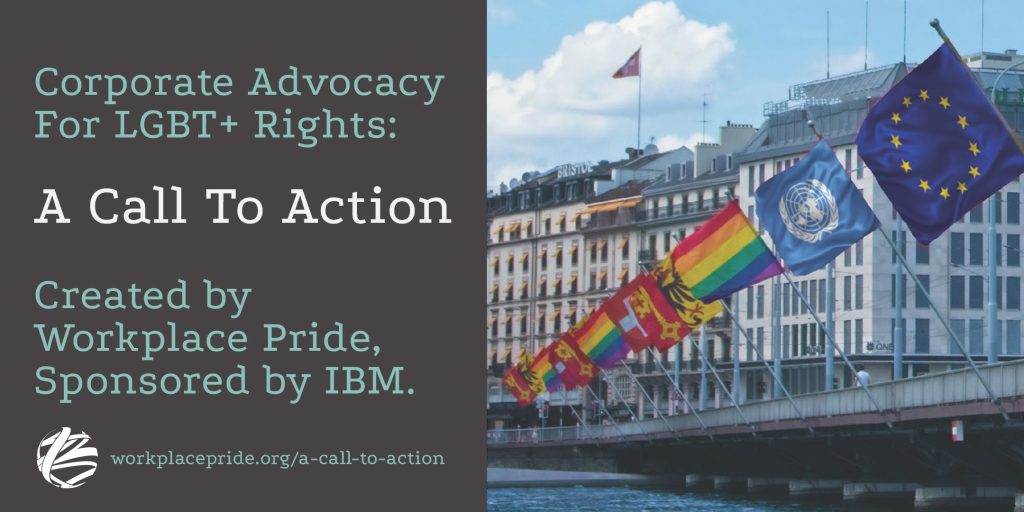
Workplace Pride’s comprehensive new white paper challenges internationally-active businesses to have a greater impact in non-LGBT+ friendly locations where they operate. 

For years businesses have been coming to terms with the fact that their presence and activities around the world have an increasingly visible impact in the communities where they work. This comes with a responsibility to their own employees, as well as to the local legislative and cultural environment. This includes Lesbian, Gay, Bisexual, Transgender, and other sexual minorities (LGBT+). In the wake of the #MeToo and Black Lives Matter movements, not to mention the global pandemic, employers realize that the workplace narrative has changed. Attracting and retaining talent from all backgrounds, creating safe workplaces for all, and being a good corporate citizen toward communities and clients, means that being silent is no longer an option. 

Workplace Pride, with support from IBM, has created this white paper to address this challenge. This ‘call-to-action’ looks in detail at basic questions of how to initiate, develop and implement successful LGBT+ corporate advocacy. The paper was created from extensive research and interviews with actual practitioners from business, diplomatic, and civil society communities. It takes a very practical approach by addressing organisational challenges and how to engage with the LGBT+ community itself while also including real-life examples of corporate advocacy initiatives around the world. 

It is our hope that, by using this paper as a ‘go-to-guide for LGBT+ international corporate advocacy’, all types of employers will be better prepared to create workplaces in which our community can feel safe, make valuable contributions and truly be themselves,” said David Pollard Executive Director of Workplace Pride. 

To explore the background and practical applications of the White Paper in more detail, Workplace Pride is hosting a webinar with the author, Dr. Felicity Daly on March 11th, 2022 at 13:00. The webinar will be open to the public. 

Interested participants should write to events@workplacepride.org, and mention “Workplace Pride Corporate Advocacy for LGBT+ Rights Webinar Registration” in the subject field. A link to the webinar will be sent to you closer to the date of the event.


Editor’s Note: For more information regarding Workplace Pride contact: Workplace Pride Executive, Director David Pollard:  e-mail: david@workplacepride.org 

The Workplace Pride Foundation is the international platform dedicated to improving the lives of LGBTIQ+ people in workplaces around the globe. Initiated in 2006, its more than 90 members employ millions of people in almost every country in the world. 

Workplace Pride Foundation – Lijnbaansgracht 298, 1017RN Amsterdam – The Netherlands – www.workplacepride.org – info@workplacepride.org  – KvK Nr. 34294570


VIEW / DOWNLOAD THE FULL PRESS RELEASE

[wpdm_package id=’10682′]

VIEW / DOWNLOAD The Corporate Advocacy for LGBT+ Rights Report

[wpdm_package id=’10719′]

Workplace Pride Launches its 2022 version of the Global Benchmark Survey

24 January 2022

We are pleased to announce that the 8th edition of our Global Benchmark Survey is officially open for registrations from February 1st until April 22nd.

Are you looking for a way to measure, manage and report on your LGBTIQ+ policies and practices? 

Created in 2014, the Workplace Pride Global Benchmark was designed to measure the LGBTIQ+ inclusion practices of internationally active employers. It also addresses the needs of organisations faced with implementing global D&I and LGBTIQ+ policies in countries where obstacles, such as legal frameworks or cultural norms make it hard to do so. 

So what does the Global Benchmark actually do?

  • Gives participants a custom-made overview of their organisations’ LGBTIQ+ policies and practices
  • Suggests practical improvements to policies and practices
  • It highlights how organisations rank among their peers through an online and print publication.
  • Awards a “Workplace Pride Global Benchmark Endorsement” for top-scoring organisations
  • Is the go-to measurement tool of LGBTIQ+ policies and practices for internationally-active employers
  • To view a Sample Global Benchmark Result report click below:

[wpdm_package id=’10627′]

Registration is free of charge to all Workplace Pride members. If your organisation is a member of Workplace Pride, you will receive the link to the Global Benchmark and a personalized code when you register at the link below.

Non-members participants pay an administrative fee of €1000 and will receive further instructions upon registration. This fee includes a detailed report of your LGBTIQ+ policies and practices in relation to your peers, along with suggestions for improvements. It also includes assistance in filling out the Global Benchmark if required.


A presentation about the Global Benchmark

To watch a short presentation (8 minutes) about the changes to this year’s Global Benchmark
Click HERE or watch below:


To find out what’s new in the 2022 Global Benchmark:

[wpdm_package id=’10653′]


We have a frequently asked questions page with tips and guidance. 


Submissions for the 2022 Global Benchmark close on Thursday, April 22nd at 24:00 (CET).


If you have any questions, please write to benchmark@workplacepride.org

Happy New Year from Workplace Pride

12 January 2022

Dear Workplace Pride members and friends,

First of all, let me wish you all a great start to the new year. 

2021 was a huge challenge for most of us with uncertainty surrounding the pandemic impacting every element of our lives and work. Despite this, Workplace Pride was able to make significant progress that has benefited our members and the LGBTIQ+ community. Milestones for the Foundation have included:

David Pollard, Executive Director

Our conference in Hungary brought together business, diplomatic, and local civil society organisations on the difficult topic of how to create inclusive workplaces for LGBTIQ+ people in a hostile political environment. 

The Academic conference organised by Workplace Pride’s special professor for LGBT inclusion at Leiden University, Dr. Jojanneke van der Toorn, was held in May of last year. This seminal event brought together scholars from around the world on the topics of LGBT workplace inclusion and was the culmination of the first 5 years of the Chair, which I am happy to say will be extended for another 5 years. 

Summer saw our first truly Hybrid International Conference held in June which pushed the boundaries of what is possible with the difficult backdrop of the pandemic. The event brought together many prominent speakers such as Jim Flittering, CEO of our member DOW Chemicals, and Lisa van Ginneken, the first transgender member of the Netherlands Parliament. 

In August the Foundation was invited by the organizers of Copenhagen World Pride to coordinate their Workplace Inclusion Day which created a forum for businesses and other LGBTIQ+ civil society organisations from across Europe and the world to take a deep dive into workplace issues from many new perspectives. 

And last but certainly not least, was our memorable Leadership Awards Gala which brought many of our stakeholders together to highlight their contribution to our movement. It was truly an unforgettable evening! 

All of this was done within the context of a significant increase of more than 25% in the number of Foundation members and everything that this entails from an organizational standpoint. 

For 2022 we will certainly continue to push the boundaries for LGBTIQ+ workplace inclusion around the world. 

In the first quarter of the year, we will be launching our white paper on LGBT corporate advocacy, we will be organising a conference for our members in Dubai and will plan webinars on various topics that support more inclusive workplaces. 

The foundation’s “jewel in the crown”, the 2022 Global Benchmark survey, opens for submissions on February 1st. and we will be making this valuable tool even easier to access for those employers wishing to make progress on LGBTIQ+ workplace inclusion.

We will also continue our work on the important Free to be me project, which is funded by the Netherlands Ministry of Foreign Affairs and which supports progress for our community in 14 countries in the global south. 

Looking further ahead, our international conference is planned for June of this year while a groundbreaking conference in Japan tackling the issues of LGBTIQ+ workplace inclusion and beyond in a unique environment is planned for the 2nd half of 2022

Workplace Pride’s special programs for women, Young people, technically focused LGBTIQ+ people and Academia will be ‘re-imagined’ as “Workplace Pride Communities” with the goal of providing them more structure and, realise greater impact for the specific groups that they represent.

And of course, our major focus of working together with our members via dedicated relationship managers and through our supportive Learning and Development program will continue and even be expanded in the coming year…. always taking into account the priorities of the LGBTIQ+ community and the many stakeholders that we work with. 

In closing, I’d like to add that, while the pandemic is far from over, a new workplace reality is on the horizon. And while LGBTIQ+ communities and individuals continue to be threatened around the world, we also continue to make tangible progress and we should not forget that.

The Workplace Pride Staff, Board, and member organisations will continue to work hard in 2022 to improve LGBTIQ+ inclusion, transforming workplaces worldwide and we invite you to join us on this very important journey. 

We wish you a Happy New Year from Workplace Pride!”