While organizational attention to the topics of workplace equality and inclusion has increased, some social groups are still disadvantaged. To support LGBTIQ+ employees at work, many organizations have LGBTIQ+ employee resource groups (ERGs). These groups are uniquely placed to provide a safe space for LGBTIQ+ employees, facilitate alliances between these employees and their ally colleagues, and advocate for structural changes in the organization.
Jojanneke van der Toorn, Workplace Pride’s Special Professor for LGBTIQ+ inclusion
In this symposium, Prof. Anna Einarsdottir, from the University of York, and Prof. Jojanneke van der Toorn, from Leiden University and Workplace Pride’s Special Professor for LGBTIQ+ Inclusion, shared insights from their recent research on the topic, discussing the promises and pitfalls of LGBTIQ+ ERGs and how they can be most effective. A panel including LGBTIQ+ ERG and HR specialists, including Workplace Pride’s executive David Pollard, reflected on the findings, shared insights from practice, and discussed how ERGs can contribute to LGBTIQ+ workplace inclusion.
The “LGBTIQ+ Employee Resource Groups: Benefits, Challenges, and Opportunities” symposium was organized by Jojanneke van der Toorn, Eva Jaspers, Chenhao Zhou, Kshitij Mor, and Paula Hoffmann, in collaboration with Academia@WorkplacePride.
First of all, let me wish you all a great start to the new year.
2021 was a huge challenge for most of us with uncertainty surrounding the pandemic impacting every element of our lives and work. Despite this, Workplace Pride was able to make significant progress that has benefited our members and the LGBTIQ+ community. Milestones for the Foundation have included:
David Pollard, Executive Director
Our conference in Hungary brought together business, diplomatic, and local civil society organisations on the difficult topic of how to create inclusive workplaces for LGBTIQ+ people in a hostile political environment.
The Academic conference organised by Workplace Pride’s special professor for LGBT inclusion at Leiden University, Dr. Jojanneke van der Toorn, was held in May of last year. This seminal event brought together scholars from around the world on the topics of LGBT workplace inclusion and was the culmination of the first 5 years of the Chair, which I am happy to say will be extended for another 5 years.
Summer saw our first truly Hybrid International Conference held in June which pushed the boundaries of what is possible with the difficult backdrop of the pandemic. The event brought together many prominent speakers such as Jim Flittering, CEO of our member DOW Chemicals, and Lisa van Ginneken, the first transgender member of the Netherlands Parliament.
In August the Foundation was invited by the organizers of Copenhagen World Pride to coordinate their Workplace Inclusion Day which created a forum for businesses and other LGBTIQ+ civil society organisations from across Europe and the world to take a deep dive into workplace issues from many new perspectives.
And last but certainly not least, was our memorable Leadership Awards Gala which brought many of our stakeholders together to highlight their contribution to our movement. It was truly an unforgettable evening!
All of this was done within the context of a significant increase of more than 25% in the number of Foundation members and everything that this entails from an organizational standpoint.
For 2022 we will certainly continue to push the boundaries for LGBTIQ+ workplace inclusion around the world.
In the first quarter of the year, we will be launching our white paper on LGBT corporate advocacy, we will be organising a conference for our members in Dubai and will plan webinars on various topics that support more inclusive workplaces.
The foundation’s “jewel in the crown”, the 2022 Global Benchmark survey, opens for submissions on February 1st. and we will be making this valuable tool even easier to access for those employers wishing to make progress on LGBTIQ+ workplace inclusion.
We will also continue our work on the important Free to be me project, which is funded by the Netherlands Ministry of Foreign Affairs and which supports progress for our community in 14 countries in the global south.
Looking further ahead, our international conference is planned for June of this year while a groundbreaking conference in Japan tackling the issues of LGBTIQ+ workplace inclusion and beyond in a unique environment is planned for the 2nd half of 2022
Workplace Pride’s special programs for women, Young people, technically focused LGBTIQ+ people and Academia will be ‘re-imagined’ as “Workplace Pride Communities” with the goal of providing them more structure and, realise greater impact for the specific groups that they represent.
And of course, our major focus of working together with our members via dedicated relationship managers and through our supportive Learning and Development program will continue and even be expanded in the coming year…. always taking into account the priorities of the LGBTIQ+ community and the many stakeholders that we work with.
In closing, I’d like to add that, while the pandemic is far from over, a new workplace reality is on the horizon. And while LGBTIQ+ communities and individuals continue to be threatened around the world, we also continue to make tangible progress and we should not forget that.
The Workplace Pride Staff, Board, and member organisations will continue to work hard in 2022 to improve LGBTIQ+ inclusion, transforming workplaces worldwide and we invite you to join us on this very important journey.
We wish you a Happy New Year from Workplace Pride!”
In the wake of a tumultuous 2020 where countless social norms were deeply affected by the global pandemic, Workplace Pride made the difficult decision to hold a truly hybrid conference at the Amsterdam Theatre on the 25th of June, 2021.
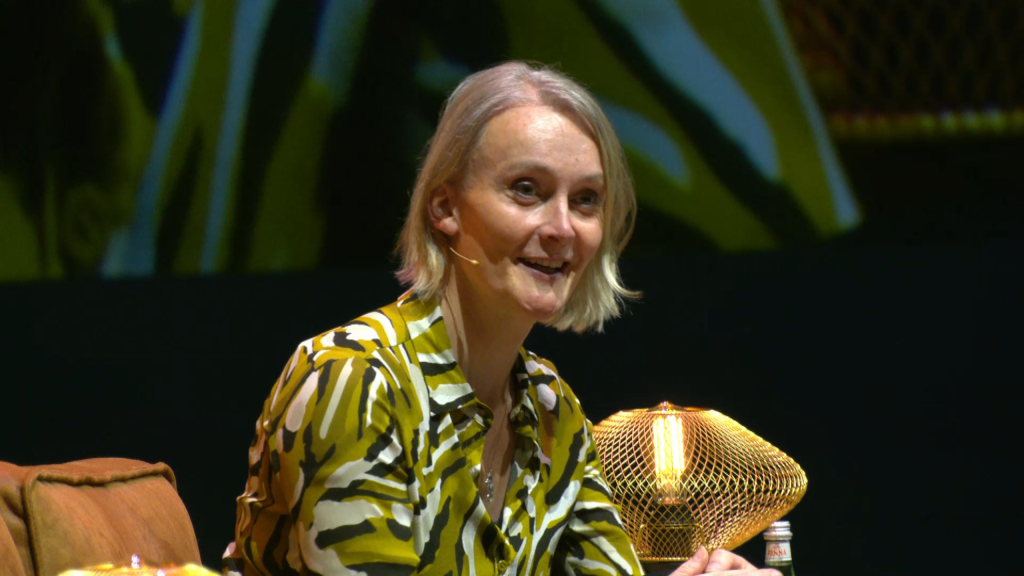
With a global online audience of over 400 and a live in-house audience of close to 100 Workplace Pride members, the conference opened with a powerful montage of the struggles and solidarity of the LGBTIQ+ communities around the world where there is still so much work to be done. David Pollard, Exec. Director of Workplace Pride opened the conference by touching on the breadth of seismic societal changes that have occurred in recent times. The changes range from the Hungarian government banning any portrayal of homosexuality in education or on television to Poland creating “LGBT-free” zones where LGBTIQ+ people have no protection against hate crimes. In Brazil, legal attempts are even being made to remove “gender” and any talk of homosexuality or transgenderism from school curricula!
“We are truly at a crossroads in how societies react to these developments and the LGBTIQ+ community is part of this story as well”
David Pollard
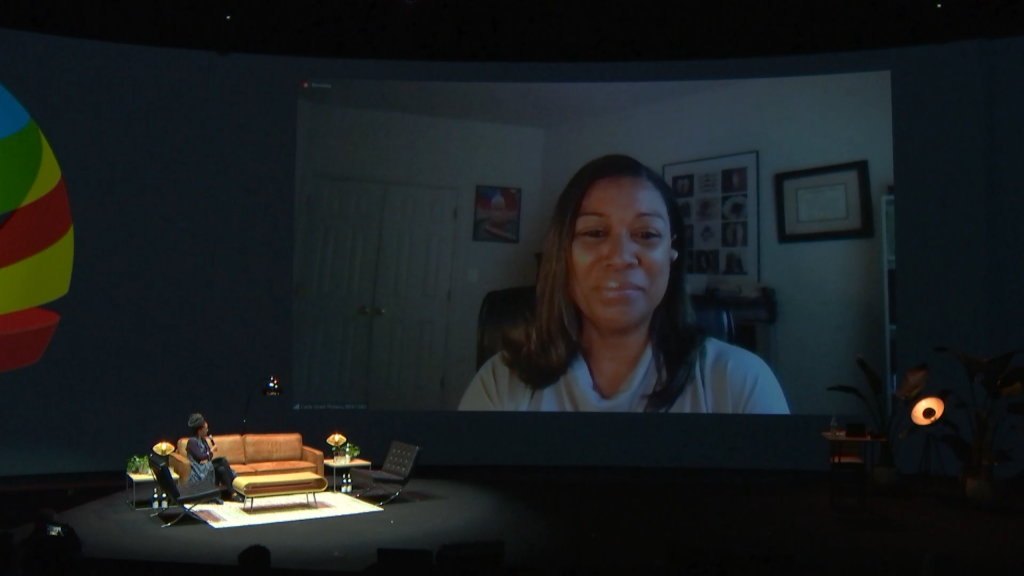
Aldith Hunkar, journalist and TV presenter was the moderator for the event and the first keynote speaker was Carla Grant Pickens, Global Chief of D&I at IBM. IBM thus far has been a trailblazer when it comes to LGBTIQ+ workplace inclusion. Aldith and Carla discussed the challenges she is facing as chief of D&I at IBM and how IBM itself is dealing with the changes to the workforce and what its core values are.
“Both physical and mental health is important. Workplace flexibility, putting yourself and yourfamily first. The concept of “whole self” is going to be key in going beyond themselves to their broader lives and ecosystem”.
Carla Grant Pickens Global Chief of D&I at IBM
Carla also spoke about the IBM Innovation Jam that was held recently which focused on the LGBTIQ+ community. With over 5000 participants worldwide it yielded insights and gave IBM actionable results around educating employees and regarding the LGBTIQ+ community.
“Companies need to ensure they pay attention to LGBTIQ+ employees’ career growth and velocity”
Carla Grant Pickens
The first panel of the day was hosted by Co-Chair of Workplace Pride, Bianca Nijhof. She spoke with Rodney Irwin, COO of the World Business Council for Sustainable Development. They were joined remotely by Marcia Balisciano, the Director of Corporate Responsibility atRELX. The discussion focused on the impact of LGBTIQ+ workplace inclusion on investors.
“There are three priorities businesses need to embrace. First the climate emergency, the biodiversity loss and its connections to COVID-19 and the third is inequality surrounding LGBTIQ+ people”.
Rodney Irwin
Marcia spoke to Rodney’s words about policies meaning nothing without action adding that RELX feels needs to have the right atmosphere across their organisation. This is accomplished through different training around topics such as psychological safety and allowing people to say what needs to be said.
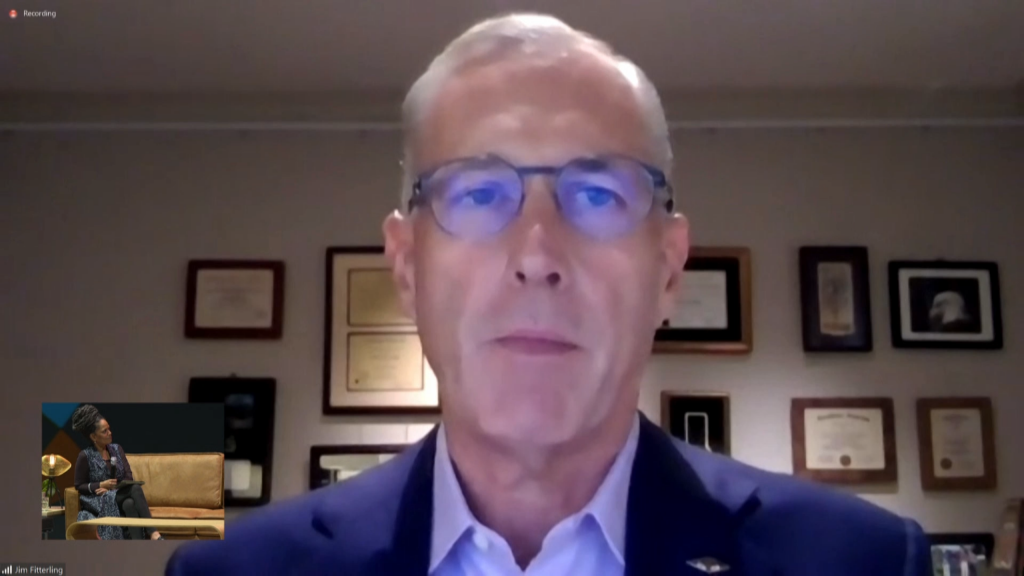
Aldith was then joined by the CEO of Dow Inc., Jim Fitterling who spoke about the gains a company can have from being more diverse and inclusive.
“You can legislate numbers, representation, and diversity and try to get there fast but if it’s not sustainable and you don’t have an inclusive culture, people can end up unhappy and leave,” said Fitterling.
“There’s a lot of awareness in the world right now, but not enough action”.
Jim Fitterling CEO of Dow Inc.
To the question of the impact of the pandemic and if employees coming back to the office was an opportunity to re-launch diversity Fitterling noted that the motto at Dow throughout the pandemic has been “Inclusion is not cancelled “. Dow’s ERG’s have been heavily relied upon to keep people connected and move forward. The pandemic provided the company with insights into life and work habits and for example, child care issues or taking care of older relatives.
Lisa van Ginneken, Member of the House of Representatives of the Netherlands joined Aldith on stage to dive straight into Lisa’s efforts around giving transgender and intersex people more say in their medical procedures. She also urged for transitional leave to cater in a similar way to maternity leave and giving attention to the process.
“Large companies have a large power to advocate and I urge them to use that power to enable low-threshold access to transgender healthcare worldwide” said van Ginneken, who added:
“Large companies have a large power to advocate and I urge them to use that power to enable low-threshold access to transgender healthcare worldwide” said van Ginneken, who added:
“When someone goes through the transition it isn’t only them, it’s their environment and their support system as well. Partners, kids, friends and family all go through the transition too”.
Lisa van Ginneken member of the house OF REPRESENTATIVES OF THE NETHERLANDS
Van Ginneken also explained that the Pandemic had affected levels of loneliness for transgender people as well. During the transition, your social circle can shrink and the Pandemic has only exacerbated those conditions along with depression. Also, since healthcare has been focused on COVID-19, transitional healthcare scope has shrunk meaning waiting lists have increased.
“I hope that in the future, formerly challenged minorities keep reminding others how it was and take on the responsibility not to treat others in a divisive way,”
Lisa van Ginneken
For the next panel featured Martine de Vries, Professor in Medical Ethics and Health law and LUMC, Gera Sneller, Coordinator for D&I at the Netherlands Ministry of Foreign Affairs, and Javier Leonor, Global Inclusion & Diversity at Accenture. With the topic of “Leaders’ Strategies at a Crossroads”, the panel gave their thoughts on healthcare and the challenges in particular for the LGBTIQ+ community.
“What we’ve learned is that we need to focus more on specific groups affected and that includes the LGBTIQ+ community,”said Professor de Vries.
For Accenture, the shift to working from home was around prior to Covid but mental health has become a key issue said, Javier Leonor. On a positive note, he also said that some employees had flourished in spite of the Pandemic. Also for transgender colleagues, some of the stress of being in transition in the office was alleviated by working from home.
Gera Sneller at the Dutch Ministry of Foreign affairs gave a very global perspective, highlighting how some areas or parts of the world moved forward with LGBTIQ+ rights but conversely other places saw things worsen during the Pandemic.
“Unfortunately we’ve seen communities, driven at the highest political level channeling the uncertainty into hatred” said Sneller.
For the final panel, Michiel Kolman, Co-Chair of Workplace Pride and SVP, Research Networks ELSEVIER spoke with Justus Eisfeld from Hivos, Yuli Kim, L+D Development Manager at Workplace Pride and Jeroen Haver, International Business Manager, NLinBusiness.
With a topic entitled “Intersectionality – A Catalyst for Change”, the discussion centered around the challenges of data representation and what that means for the intersex community in particular, and are we acknowledging that community’s significant difficulties in finding and having employment for example.
The discussion delved deeper into the “framework” of intersectionality beyond the obvious visual characteristics.
“It’s time to apply a different lens when we look at intersectionality. Not just the LGBTIQ+ lens but also generation, race, culture and language, and many more invisible characteristics” concluded Kolman.
This first true ‘hybrid event’ by Workplace Pride highlighted the advantages of being able to gather again in person, but at the same time showcased the ongoing challenges that many LGBTIQ+ people and their employees face in the workplace as a result of the societal changes we are all experiencing. Going forward, Workplace Pride will continue to challenge our members and the community to strive for more inclusive workplaces around the world: together with can choose the right path at this monumental turning point in our history.
Although LGBTIQ+ people are protected by laws addressing employment and other forms of discrimination in a growing proportion of countries, there remain far too many LGBTIQ+ people around the globe whose rights are not protected. In many countries, LGBTIQ+ citizens are breaking laws just by being themselves. Even in legally progressive nations, many LGBTIQ+ people still feel that they cannot reveal their authentic identity in many professional, academic, and social settings.
To continue advancing inclusion and belonging for the full spectrum of the LGBTIQ+ community at work, home, and society at large, the IBM Institute for Business Value (IBV) is collaborating with Workplace Pride, and Out & Equal to host a Global LGBTIQ+ Innovation Jam.
Starting at 8am ET on Tuesday, April 13th and running continuously through until 5pm ET on Wednesday, April 14th, the Jam is a virtual, text-based event where thousands of business leaders; D&I experts; academics; and other allies will come together to explore the solutions to the barriers that still slow the advancement of LGBTIQ+ individuals in the workplace.
The Global LGBTIQ+ Innovation Jam is an open and inclusive forum for discussion and sharing around 7 important themes:
Corporate & individual championship
LGBT+ intersectionality
Mental health
Transgender and non-binary belonging
Allyship
Visibility and development
Impact of technology
Register for the Global LGBT+ Innovation Jam and join the discussion – for a few minutes or for all 33 hours! Input from Jammers will be analyzed by IBM’s proprietary Innovation Jam® AI-enabled technology and the results may be used to inform an upcoming LGBT+ Leadership study that is being published in celebration of Pride Month in June.
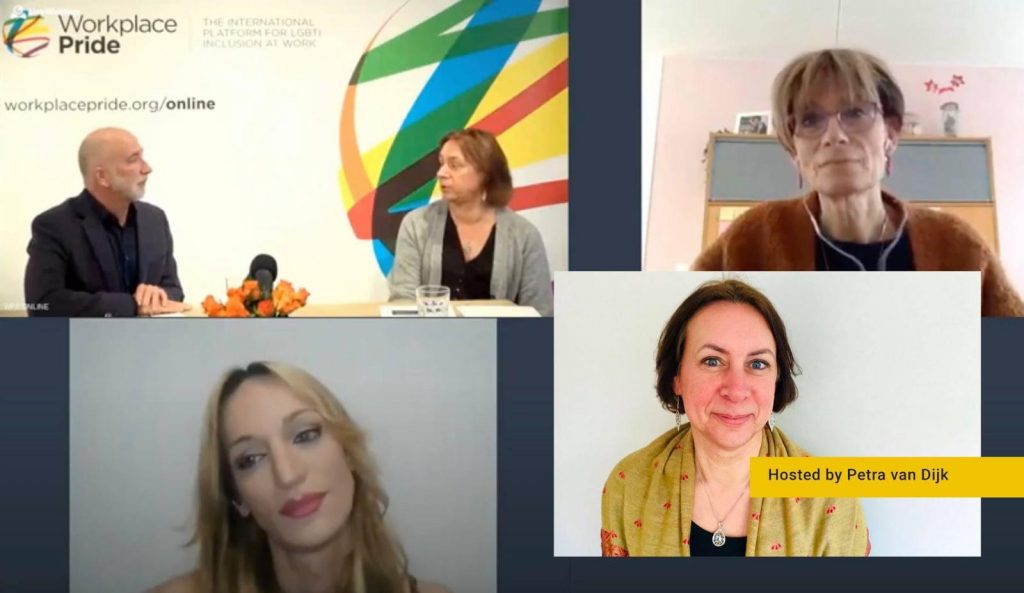
In our latest webinar in the Keeping Members Connected series, Workplace Pride hosted Petra van Dijk from Transwerkt Nederland along with Remke Verdegem of TNN (Transgender Network Nederland. We also had a guest dial in all the way from Argentina, Maryanne Lettieri of Contrata Trans.
Firstly, Petra introduced Transwerkt Nederland and explained what and how her organisation assists trans people with, at numerous stages of their working lives and careers. Unilever for example in the Netherlands is uniquely pioneering forward by having a gender transition policy. Such essential policies are something Petra is very passionate about going forward.
Remke talked about her work with TNN explaining some of the statistics around trans people in the Netherlands and how the binary generation is being succeeded by the “gender fluid” generation.
Since both Transwerkt Nederland and TNN are based in the Netherlands, Maryanne from Contrata Trans brought an international focus on the issues of trans people in Argentina. Maryanne talked about socio-economic plight of trans people and how they are marginalised and are often forced through adversity into the sex industry there.
As always, we had a live international audience who contributed great questions to our fascinating panel!
Timestamps (click the red timestamp to jump straight to that part of the webinar) 0:00 Introduction by David Pollard
1:45 Panel introductions (Petra, Remke and Maryanne)
Coming out is a pivotal moment and process for nearly everyone in our community. Whether you to choose to come out or not, this is a day to inspire you to think about the profound importance of being yourself.
For those that take this brave decision, it can bring out an authenticity and honesty to themselves, positively affecting potentially all aspects of life from the home to the workplace and beyond.
Workplace Pride is delighted to celebrate this years Coming Out Day with an excellent article written by Joris Hoekstra who currently works at Deloitte.
Coming Out Day 2020: a call for awareness and dialogue
I used to feel uncomfortable with Pride and Coming Out Day. Extravagant men in weird outfits on a boat. What image would that give us? And a special day to come out of the closet. Why on earth is that necessary? These days I see a tremendous value and necessity for events like these and with this message I would like to address the role we can play as employers and as individuals.
Joris Hoekstra
The bitter and absolute necessity
Previously I was insufficiently aware of the (sometimes lifelong) struggle that LGBT people in The Netherlands and other countries have to cope with. I was insufficiently aware of the fact that in The Netherlands it was since 1994 that a General Equal Treatment Act was realized and that gay marriage was possible only since 2001. I was insufficiently aware of the internalized homophobia, shame, hyper-self-awareness and overcompensation to be loved and accepted (after learning that who you are is bad or at least deviant) that many gays and myself have to deal with. Let alone the higher rate of mental health problems, addiction and suicide among LGBT people.
Fortunately, there are also positive developments such as the much greater extent to which schools educate their students and create awareness for inclusion and events like Coming Out Day. Not too long ago when I was in high school there was no education or guidance at all. Employers are also increasingly taking their responsibility. I would like to elaborate on this.
Inclusive working environment
In my view, employers play a crucial role when it comes to creating inclusion. After all, most people spend most of their week on school or work. Studies show that a positive school or work climate contributes 82% to a feeling of belonging as a LGBT. Employers are increasingly doing their best to create a safe working environment regardless of cultural background, gender, religion and sexual preference. This often manifests itself in facilitating diversity networks, participating in events such like Pride and Coming Out Day to create visibility. Of course this has a positive effect on the employer brand and their ability to attract a diverse and high-performing workforce, but in my view it has an even bigger impact than simple window dressing. Not only do employers send a message to their employees that they value a safe and inclusive working environment, they also send a clear and important message to other organizations and governments (even internationally). In my view, the support of large international organizations is of unprecedented importance.
I am fortunate that both my previous employer Rabobank and my current employer Deloitte (as well as the client relationships I have worked for) make a strong effort to create and radiate an inclusive work environment. For example, two years ago I was on a Deloitte Pride boat and throughout the year I experienced that my employer really makes an effort to create an inclusive environment and enables us to be our authentic selves.
Daily challenges and dialogue
Nevertheless, I also want to reflect on the challenges that I and many others might have in daily life. In addition to social challenges (I am still very reluctant to show affection in public towards my boyfriend, often dream about incidents of discrimination and violence and I carefully choose my holiday destinations ) there are also challenges in the working environment. What do you do if you are offered an assignment in a country where your sexual orientation is against the law? Do you dare to be yourself in a boardroom setting (which often still consists of middle-aged white men)? Do you mention you have a boyfriend and would that influence your career? How do you deal with a quiz at a team event where all the questions focus on having a partner of the opposite sex, leaving you the only one who can’t participate? How do you deal with invitations or conversations assuming you have a girlfriend? Does your male colleague feel uncomfortable sharing a room with you? And can you be yourself towards international colleagues and client relations from countries where homosexuality is rejected or even illegal?
There are many more examples and they all have one thing in common: having a dialogue about it leads to more awareness, understanding and connection. I have experienced that discussing uncomfortable and challenging situations in the working environment always results in an open conversation, confirmation of the positive intentions of the other and deepening of the relationship. And ultimately increase the feeling of belonging, of inclusion. I encourage everyone to have a dialogue about this and in this way to take responsibility for a healthy, inclusive and above all a pleasant working environment.
Grateful call for dialogue
I myself am very grateful that my parents accepted me for who I am, that I have loving friends and colleagues, that I have a loving relationship in which vulnerability around this subject is possible, and that I live in a country that is relatively safe and inclusive for LGBT. At the same time I see many people in both The Netherlands and abroad struggle and suffer. I want to emphasize once again the importance of creating awareness. Every day in your life, in the workplace and on specific days like today.
In a time when having dialogues and celebrating special days are a little different from normal, I hope more than ever that this day will contribute to the safety and inclusion that we all deserve. Celebrate this day with me!
Happy Coming Out Day!
Agency Organizes Re-integration of Trans People at Work
Being transgender in the workplace has always come with significant challenges. Whether this is the communication process with your colleagues, arranging leave for medical procedures, or the sheer uniqueness of a person’s transition for the organisation, it can be both daunting and frustrating.
Now, however, there is a new agency ‘Transwerkt Nederland’ (Trans Works Netherlands) which facilitates this process for both the person transitioning and the organisation through an integral approach putting the transitioning person in the middle point. As an initiative of the well established re-integration bureau “Job Coach Connect”, and at the request of Workplace Pride member UWV and civil society organisation TNN (Transgender Network Netherlands), this initiative has huge potential for both the transgender community and their employers.
In the article below, Petra van Dijk of Transwerkt Nederland tells her own story and relates how the tide has turned for the better for transgender people in Netherlands’ workplaces.
Later this fall, Workplace Pride office will be hosting a webinar with Transwerkt Nederland and dive into more detail about the complex issue of being transgender in the workplace.
Trans Werkt Nederland Supports Transgender People
About a year ago, a re-integration agency called Jobcoach Connect, was invited by Workplace Pride member, UWV and TNN (Transgender Network Netherlands) to tackle the low employment rate of transgender people in The Netherlands, through guidance and job coaching. This new initiative is called ‘Trans Werkt Nederland’ (Trans Works Netherlands)
From a study conducted in 2017, we learned that almost 20% of transgender people are unemployed or incapacitated and that 28% have a net income of less than €1.000 per month, despite 41% of them being well educated.
As a qualified job-coach and a experiential transgender woman, I think I can make a difference when it comes to empowering trans people. Be it helping them find work or to resolving challenges in their workplaces. I recently joined Trans Werkt Nederland because I think it’s important that the talent of transgender people is not wasted and that transgender people can function perfectly just like any other employee.
A lot of improvements still have to be made for LGBTQI+ people in the workplace. Recently, a consultancy organization called ‘Berenschot’ conducted a survey that showed that only 20% of Dutch companies have an active diversity policy. Another survey by IT service provider ‘Peak-IT’ showed that 20% of the supervisors and HRM managers are hesitant to hire a transgender person!
These times are very challenging. We’ve had the #metoo discussion, and the horrible death of George Floyd that outraged the world. The #blacklivesmatter movement demands the end the discrimination of people of color and ending institutionalized racism.
In the midst of all this, we have the COVID-19 pandemic. Millions of people all over the world are infected, many getting sick. Lots of companies struggle: less work, employees working at home, decisions made on whether to continue with providing government support or letting people go or maybe even going bankrupt. Many are unemployed as a result, often being the most vulnerable with flexible or temporary contracts, young people working in the catering industry and the self-employed.
Recent developments in Hungary and Poland show that some European countries are not being progressive in their legislation for the LGBTQI+ community.
The recent ILGA Rainbow Index shows no progress for the LGBTQI+ situation in Europe.
However, I personally feel that times are slowly changing overall for the better for LGBTQI+ people. But at the same time I realize that I am very privileged as a Dutch, white, well-educated trans woman with a strong character and lots of support in my life. I know that many trans people are struggling, even in The Netherlands. Especially trans people of color, religious trans persons and sex-workers.
Workplace Pride appoints new co-chairs to further foster LGBTI-inclusion
Amsterdam, June 22 2020 – Workplace Pride – a nonprofit foundation dedicated to improving the lives of LGBTI-people in workplaces worldwide – announced two new co-chairs to its Foundation Board. Michiel Kolman (Senior Vice President at Elsevier) and Bianca Nijhof (Managing Director at Netherlands Water Partnership, NWP) are taking over the reins from Mark Emdin, who has chaired the Foundation for six years. Both have committed themselves to enhancing LGBTI rights as new co-chairs and to addressing LGBTI workplace inclusion – which is more relevant today than ever before.
In an historic ruling issued last week, the United States’ Supreme Court decided that LGBTI people can no longer be formally discriminated against in the workplace. While this ruling has far-reaching implications for millions of American workers and opens the door to challenging other discriminatory practices, the state of affairs is not improving in many other countries and regions.
Limited priority for diversity and inclusion within organizations
An important task awaits the new co-chairs. Apart from the most distressing cases – such as the growing body of anti-LGBTI legislation in Poland and Hungary – discrimination and LGBTI-inclusion remains problematic in many regions and organizations. . A Berenschot research published last weekshows that for most companies in the Netherlands, diversity and inclusion are still not a priority: Only 20 percent of the surveyed companies pursue an active diversity policy and for most companies, diversity and inclusion were near the bottom of their priority list.
In addition, the current pandemic may be an incentive for governments and organizations to move diversity and inclusion further down their list of priorities. This is bad news not only for the LGBTI-community, but also for companies and governments, as an increasing body of literature shows that inclusion and diversity are strongly related to innovation and growth. Inclusion and diversity are not only a moral duties – they are assets, according to the new co-chairs.
About the new co-chairs of Workplace Pride: Michiel Kolman and Bianca Nijhof
During their careers, Michiel Kolman and Bianca Nijhof built up an extensive resumé when it comes to fostering LGBTI-inclusion in the workplace. In- and outside their respective organizations Elsevier and NWP, the two are recognised as prominent advocates of workplace inclusion. Both are already members of the Workplace Pride Board.
Michiel Kolman is Senior Vice President Information Industry Relationsat Elsevier andSpecial Envoy for Diversity and Inclusionat the International Publishers Association. At his employer, Kolman has been the driving force behind the coming about ofElsevier Pride. In 2014 and 2015, he was included in the OUTstanding 100, a list of LGBTI business leaders composed by the Financial Times.‘The business case for LGBTI inclusion has never been more compelling. Emphasis on diversity and inclusion is strongly correlated to innovation and creativity. Inclusion does not only benefit members of the LGBTI community, it is an asset to organizations and their cultures’, Kolman said regarding the announcement. During his time as co-chair, Kolman will commit to strengthening the academic pillar of the Foundation.
Michiel Kolman, Co-Chair Workplace Pride Foundation, June 2020
Bianca Nijhof is Managing Director at Netherlands Water Partnership. At previous employers as a member of the D&I team and now as the director she strives for a diverse and inclusive working environment. She is also the coordinator for the SDG 6 Alliance of The Netherlands working closely with the other SDG coordinators to achieve a better and more sustainable future for all.‘I am proud to become co-chair together with Michiel for the Workplace Pride Foundation Board. Especially during these difficult times, when many existing norms are challenged, we need to think more intensively about implementing diversity and inclusion in its many forms. During my time as co-chair, I want to contribute to a world in which everyone has a say in the coming about of new standards’, Nijhof commented on her announcement as co-chair.
Bianca Nijhof, Co-Chair Workplace Pride Foundation, June 2020
[wpdm_package id=’7725′]
–END OF PRESS RELEASE –
Note for the press
For questions or interview requests, please contact; David Pollard – Executive Director at Workplace Pride Foundation, via david@workplacepride.org or Simone Schuilwerve –Communication Advisor at Issuemakers, via s.schuilwerve@issuemakers.nl.
About Workplace Pride
Workplace Pride Foundation is the international, not for profit platform for the inclusion of Lesbian, Gay, Bisexual, Transgender and Intersex (LGBTI) people at work. Its many members employ more than 4.5 million people worldwide. Initiated in 2006 with 4 corporate members Workplace Pride has seen enormous membership growth over the last years, leading up to more than 70 members today. Diversity among the members has been increasing with corporates (e.g. IBM), governments (e.g. Dutch Rijksoverheid), academic institutions (e.g. Leiden University), NGOs (e.g. Oxfam Novib) currently among the Foundation’s members. In recent years the Foundation has seen a surge in international activities at the request of its members, attracting organizations and individuals from across the globe. The Foundation has organised activities in countries ranging from Nairobi to Manilla, and from Singapore to Moscow.
Workplace Pride’s important results
In January 2017, Workplace Pride and Leiden University created the world’s first university professorship (Chair) dedicated exclusively to LGBTI workplace inclusion. The Workplace Pride Chair holder is Dr. Jojanneke van der Toorn. With the generous support of Foundation Member KPN, the 5-year duration of the Chair has taken this topic to a new level of scientific scrutiny, benefiting employers, employees, the academic world and the LGBTI community alike.
As of today close to 30 members have signed the Declaration of Amsterdam spelling out their commitment in 10 areas to achieve LGBTI workplace inclusion.
Around 40 members are participating annually in the Global Benchmark which will allow these organizations to see how they compare to others in 8 key areas of LGBTI workplace inclusion.
In 2020, Workplace Pride launched its toolkit for the United Nations LGBT Standards of Conduct for Business. This practical and tested business tool helps organizations implement their LGBTI policies and practice across the globe. The Toolkit has received the endorsement of both the United Nations and the Dutch Ministry of Foreign Affairs.
Historic Ruling Against LGBTI Workplace Discrimination
Workplace Pride is absolutely delighted with the USA Supreme Court ruling that LGBTI people can no longer be discriminated against in the workplace in the United States. This 6 to 3 ruling is both groundbreaking and historic and will have far-reaching implications around the world; particularly in those countries and regions of the world that have relied on populism to support homophobia, biphobia and transphobia – even in the workplace.
“While probably a coincidence with the Black Live Matters events and the emerging ‘civil rights movement version 2” , the timing of this ruling really could not be more significant.” said David Pollard, Executive Director of Workplace Pride Foundation. “It is a clear signal that LGBTI people, along with people of colour, and anyone else who feels marginalised, has a fundamental human right to be respected in society and treated as equals in the workplace”.
In the greater context of LGBTI workplace inclusion this ruling shows that, at least in the USA, the largest marketplace in the world, employers now have all the tools at hand to create workplaces that are truly inclusive and based on merit; not the colour of a person’s skin, identity, physical ability, gender or, indeed who they love.
Workplace Pride encourages all employers to now apply this same level of inclusion for LGBTI people in all of their activities around the world. Where they encounter resistance due to colonial-era laws or claims of ‘cultural inappropriateness’, it will be useful to remember that these, often antiquated concepts are now being universally challenged. It is also useful to remember that the LGBTI community and our many allies, (including investors as this Bloomberg article refers to) will always be mindful of those organisation who are supportive.
Finally, for Workplace Pride, our members, and our many friends and colleagues in the LGBTI community this is a validation that we are on the right track with our efforts. But it is also a reminder that there are still many places around the globe where LGBTI people cannot be themselves. It is our hope that this ruling will empower all employers to take a good hard look at where we are and where we all still need to go…together!
Workplace Pride Foundation is pleased to announce the publication of our Toolkit for the United Nations Standards of LGBTI Business Conduct. This toolkit is designed as a one-stop-shop to help organisations implement the general principles outlined in the Standards of Conduct. It takes practical examples gathered from Workplace Pride member organisations, good practices from our Global Benchmark, as well as data from extensive interviews with practitioners to create a comprehensive guide to achieving greater LGBTI inclusion in the workplace
The toolkit was developed in conjunction with Workplace Pride’s Advisory Board member, Graham Sparks and was launched in episode five of the Foundation’s “Keeping Members Connected” webinar series. In the webinar, Graham sets the context and guides us through, in a step by step approach, how to use it, why the toolkit is practical for organisations, and how it can be leveraged by all types of employers. Most importantly, he demonstrates that this toolkit can also be used by LGBTI civil society organisations to interact with businesses and better understand how they can work collaboratively.
While primarily designed for Workplace Pride members, who have access to a greater degree of toolkit material, the basic toolkit is publicly available and contains a wealth of information for all parties.
This website uses cookies to improve your experience. We'll assume you're ok with this, but you can opt-out if you wish. Cookie settingsACCEPT
Privacy & Cookies Policy
Privacy Overview
This website uses cookies to improve your experience while you navigate through the website. Out of these cookies, the cookies that are categorized as necessary are stored on your browser as they are essential for the working of basic functionalities of the website. We also use third-party cookies that help us analyze and understand how you use this website. These cookies will be stored in your browser only with your consent. You also have the option to opt-out of these cookies. But opting out of some of these cookies may have an effect on your browsing experience.
Necessary cookies are absolutely essential for the website to function properly. This category only includes cookies that ensures basic functionalities and security features of the website. These cookies do not store any personal information.
Any cookies that may not be particularly necessary for the website to function and is used specifically to collect user personal data via analytics, ads, other embedded contents are termed as non-necessary cookies. It is mandatory to procure user consent prior to running these cookies on your website.